A custom coaster is a small print job with a surprising number of decisions packed into it. Get the size, thickness, and artwork setup right and the coasters arrive looking sharp and sitting flat under a glass. Get them wrong and you end up with a logo cropped at the edge, a mat so thin it curls after one wet night, or a size that swims under a pint glass. This walkthrough moves through the specification in the order a printer will ask about it, so you can hand over a brief that leaves nothing to guess.
Start with size and shape
Coaster sizes cluster more tightly than most people expect. In North America the everyday square coaster runs 4 inches on a side, about 102 millimeters, while classic beer coasters are often a slightly smaller 3.5 inches. Round coasters sold for bar use typically land between roughly 90 and 105 millimeters in diameter, with 90mm, 95mm, and 100mm being the workhorse options. A 3.5-inch round works out to about 89 millimeters, which is why so many quotes list similar-sounding numbers. Sizes larger than about 105 millimeters and specialty formats up to 6 inches exist, but they read as novelty and cost more per piece.
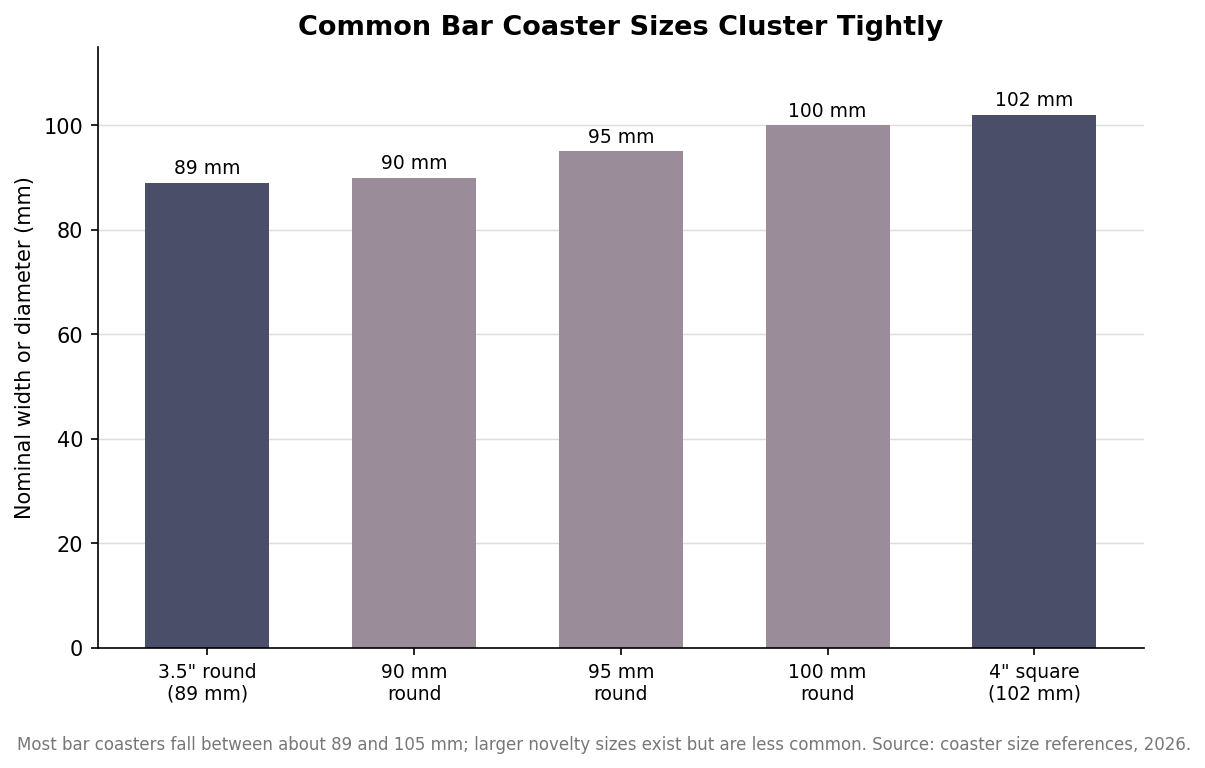
Match the size to the glassware, not just the logo. A 90 to 95 millimeter round comfortably catches the base and condensation of a standard pint or highball, while a 4-inch square gives a little more print area and a more contemporary look. If your venue serves wide-bottomed cocktail glasses or steins, size up to 100 millimeters or the 4-inch square so the rim never overhangs the mat. Shape is mostly an aesthetic call, though square coasters pack and stack more efficiently and give straight edges for a border, while rounds feel more traditional behind a bar.
Reading thickness: points, millimeters, and feel
Thickness is quoted two ways, and knowing both keeps you from over- or under-ordering. Printers often use points, where one point equals one thousandth of an inch, so a 40-point board is 0.040 inches, right around 1 millimeter. That lightweight stock suits single-use giveaway mats. A 60-point board, near 1.5 millimeters, is a sturdier everyday weight. Commercial bar and restaurant coasters commonly run about 80 points, close to 2 millimeters, thick enough to feel substantial and to soak up spills through a full shift. Premium and specialty boards climb to 100 points and beyond. The relationship is linear, so once you know that 80 points equals roughly 2 millimeters, you can translate any quote in your head.
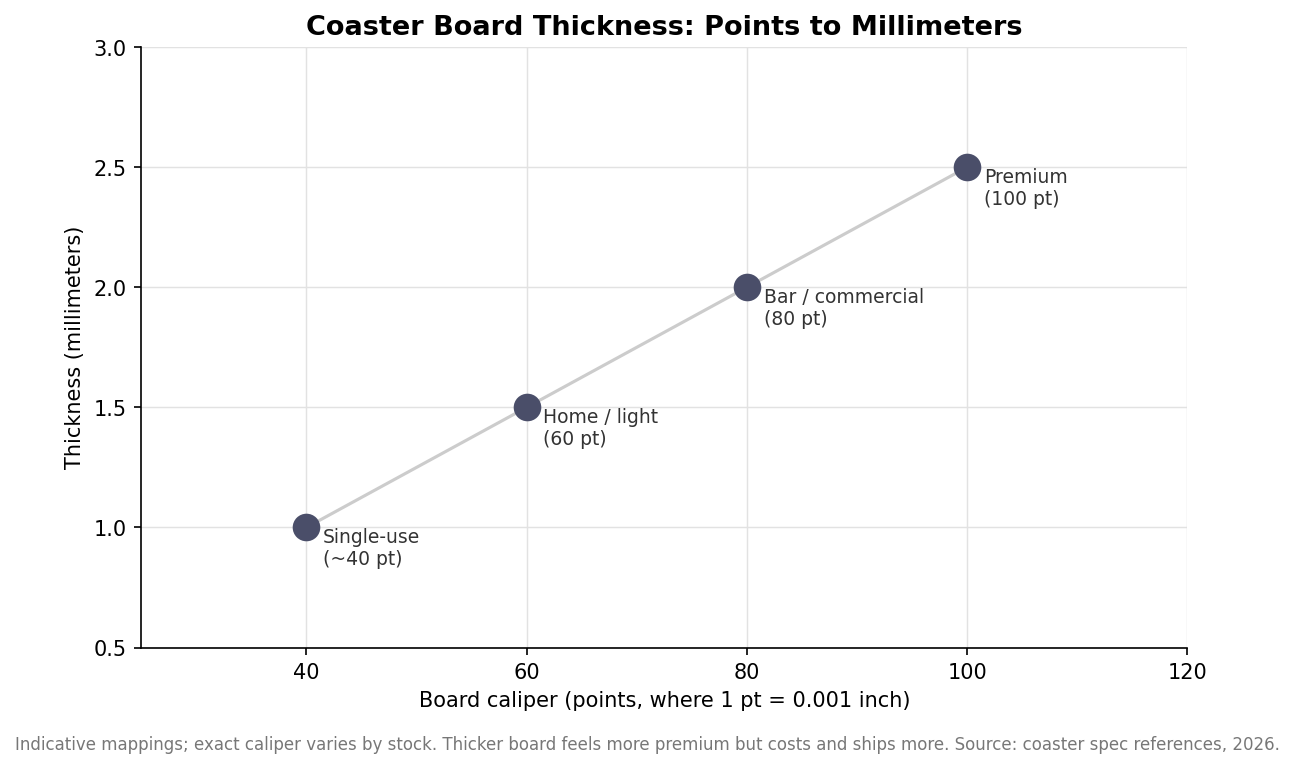
Thicker is not automatically better. Heavier board feels more premium in the hand, resists curling, and lasts longer, but it also costs more per unit and adds shipping weight across a large order. For a promotional coaster that a customer takes home once, a lighter board is fine. For a coaster that lives on the bar and gets wet dozens of times a day, spend the extra for 80-point stock or heavier, because absorbency and rigidity are exactly what you are paying for.
Set up artwork for a clean cut
The single most common cause of a disappointing coaster is artwork that was not built for trimming. Printers cut through a stack of board, and the blade never lands in precisely the same spot on every piece, so your file needs to account for that tolerance in two directions. First, extend any background color or image past the finished edge to create bleed; a quarter inch of bleed beyond the cut line is a common requirement and keeps a stray white sliver from appearing if the cut drifts outward. Second, pull anything you cannot afford to lose, logos, text, and key graphics, inward from the edge into a safe area, typically about three sixteenths of an inch inside the cut line, so nothing important gets shaved off if the cut drifts inward.
Build the file at print resolution in the right color space. Artwork should be 300 dpi or higher at the actual finished size, and it should be supplied in CMYK rather than RGB, because that is how the press mixes ink. A logo that looks crisp on screen at 72 dpi will print soft and pixelated, and bright RGB colors can shift noticeably when converted to CMYK, so it is worth confirming your key brand colors as CMYK or spot values before you approve anything. Vector files, such as an Illustrator EPS or a properly built PDF with outlined text, reproduce most reliably because they scale without losing sharpness.
Stock, absorbency, and finish
The board itself shapes how the print looks and how the coaster performs. Uncoated pulpboard is absorbent and matte, giving that traditional beer-mat feel and soaking up condensation, though colors read a touch softer as the ink sinks in. Coated or heavier coaster boards hold color more vividly and can take a smoother finish, at the cost of some absorbency. If your design is a full-bleed photograph or a rich solid color, a coated stock will make it pop; if the coaster’s main job is catching drips on a busy bar, absorbency should win. Ask to see the stock options, and if you can, request a physical sample so you can judge both the print and the way the board handles a splash of water.
Quantities, proofs, and lead time
Custom coasters are usually priced in tiers, so the per-piece cost drops sharply as quantity rises; ordering 5,000 rather than 1,000 often costs far less than five times as much. Decide your real quantity before requesting quotes so you are comparing the same volume across vendors. Always ask for a proof, ideally a printed one but at minimum a digital layout showing the cut line, bleed, and safe area, and check it against your file before you approve production. Confirm the lead time in writing too, since coaster runs commonly take one to three weeks depending on stock, finishing, and shipping, and event coasters in particular need a comfortable buffer. A short pre-order checklist keeps you honest: finished size and shape chosen, thickness specified in points or millimeters, artwork built at 300 dpi in CMYK with bleed and a safe area, stock selected, quantity locked, and a proof reviewed. Run through those six items and the coasters that arrive will match the ones you pictured.