Disposable pulpboard is the right answer for a busy bar, but it is not the only coaster a brand orders. Breweries selling merch, hotels dressing a lobby bar, real estate offices assembling closing gifts, and event planners building welcome kits all reach for reusable coasters, and there the material choice gets more interesting. Cork, neoprene, sandstone, ceramic, slate, wood and acrylic each behave differently in the two ways that matter most: how they deal with a sweating glass, and how well they carry your artwork. This guide walks through the reusable options with the specifics that separate a coaster people keep from one that warps, slides, or prints muddy.
The first fork: absorb the condensation, or wipe it away
Every reusable coaster answers the condensation problem in one of two ways. Absorbent materials, such as cork and natural stone, pull the moisture into the coaster and let it evaporate between uses. Closed-cell and sealed materials, such as neoprene, acrylic and glazed ceramic, do not soak anything up; they simply keep the ring off the furniture and get wiped down. Neither approach is better in the abstract, but they fail differently. An absorbent coaster left permanently wet can grow musty, while a non-absorbent one can let a puddle slide the glass around. Decide which behavior your setting wants before you shop on looks.
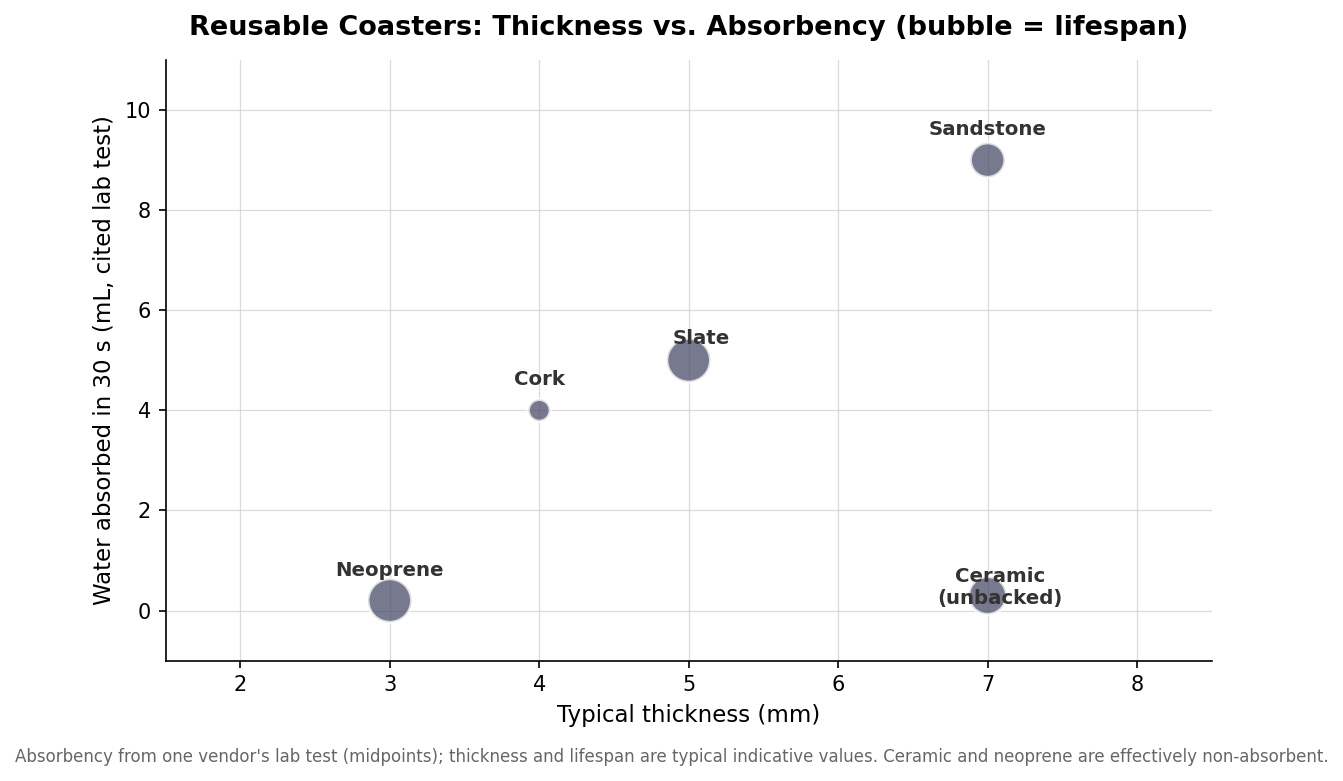
The numbers make the split concrete. In one vendor’s lab testing, sandstone absorbed roughly 8 to 10 milliliters of water in 30 seconds and slate 4 to 6, while cork took up about 3 to 5. Neoprene and unbacked ceramic, by contrast, absorbed essentially nothing. The scatter below plots that absorbency against typical thickness, with bubble size standing in for how many years each material tends to last.
The absorbent camp: cork, sandstone and ceramic
Cork is the workhorse of reusable absorbent coasters. At a typical 3 to 5 millimeters thick it is light, naturally grippy, renewable, and cheap, and it takes screen, UV and laser decoration well. The tradeoff is lifespan: cork is often cited at roughly one to three years of real use before the edges crumble and stains set in, so it suits promotional runs and giveaways more than permanent barware.
Natural stone is the absorbency champion. Sandstone and similar porous stone wick condensation fast, which is exactly why the well-known absorbent-stone coasters use it. The catches are weight and fragility, since stone is thick, around six to eight millimeters, heavy in a stack, and prone to chipping if dropped, and it needs a cork or rubber backing to protect the table and add grip. Decoration is usually a dye or ceramic-style transfer, which handles logos and full-color art but with slightly softer edges than a printed surface.
Ceramic is the confusing one, because most glazed ceramic is not absorbent at all; the glaze seals the surface. Only unglazed or specially bisque-fired ceramic drinks anything in, and even then makers usually add a cork base. What ceramic does offer is a hard, printable face with a genuinely long life, commonly five to seven years, and support for screen and transfer printing. If a supplier calls a glossy ceramic coaster absorbent, ask whether the drinking side is actually unsealed.
The wipe-clean camp: neoprene and acrylic
Neoprene has become the default for full-color branded coasters, and the reason is durability plus print range. The fabric top takes dye-sublimation printing, so photographs, gradients and complex logos all reproduce cleanly, and the closed-cell foam gives excellent non-slip grip. In the same lab testing referenced above, neoprene coasters were reported to survive more than a thousand wash cycles without losing shape or print, outlasting cork by roughly fourfold, and they are typically dishwasher-safe and resistant to mold and odor. At about three millimeters thick they are non-absorbent by design, functioning by keeping the ring off the surface rather than soaking it up, which is a fine tradeoff for anyone who would rather wipe a coaster than dry it.
Acrylic sits at the premium, display end. It is non-absorbent, rigid, and takes vivid printing, often with the art on the underside so the glossy top protects it, which makes it a favorite for upscale bars and retail. The downsides are that it offers little grip unless it has rubber feet, it scratches, and it is the least eco-friendly option here. Reserve it for looks-forward settings rather than high-volume service.
Slate, wood and the look-first materials
Slate and wood are chosen for their appearance first and their function second. Slate reads upscale and rustic, is moderately absorbent at roughly four to six milliliters in the same testing, and is durable, but it is heavy and generally limited to laser-engraved or single-color branding rather than full color. Wood and bamboo look warm and are renewable, but bare wood barely absorbs and can stain or swell unless it is sealed, and like slate it is best decorated by laser engraving, which means a tone-on-tone mark rather than a colorful print. Both are excellent for gift and retail coasters where the material itself is part of the message, and weaker choices where spill control or vivid color is the priority.
Matching the material to the job
Because no single material wins on everything, the practical move is to rank the two or three attributes that matter for your use and pick accordingly. A brewery tasting room that wants photographic label art and daily washing leans neoprene. A boutique hotel bar that wants condensation actually absorbed leans sandstone or cork. A closing gift that should look expensive on a desk leans slate, wood or acrylic. The matrix below rates each material across the jobs a coaster is usually asked to do.
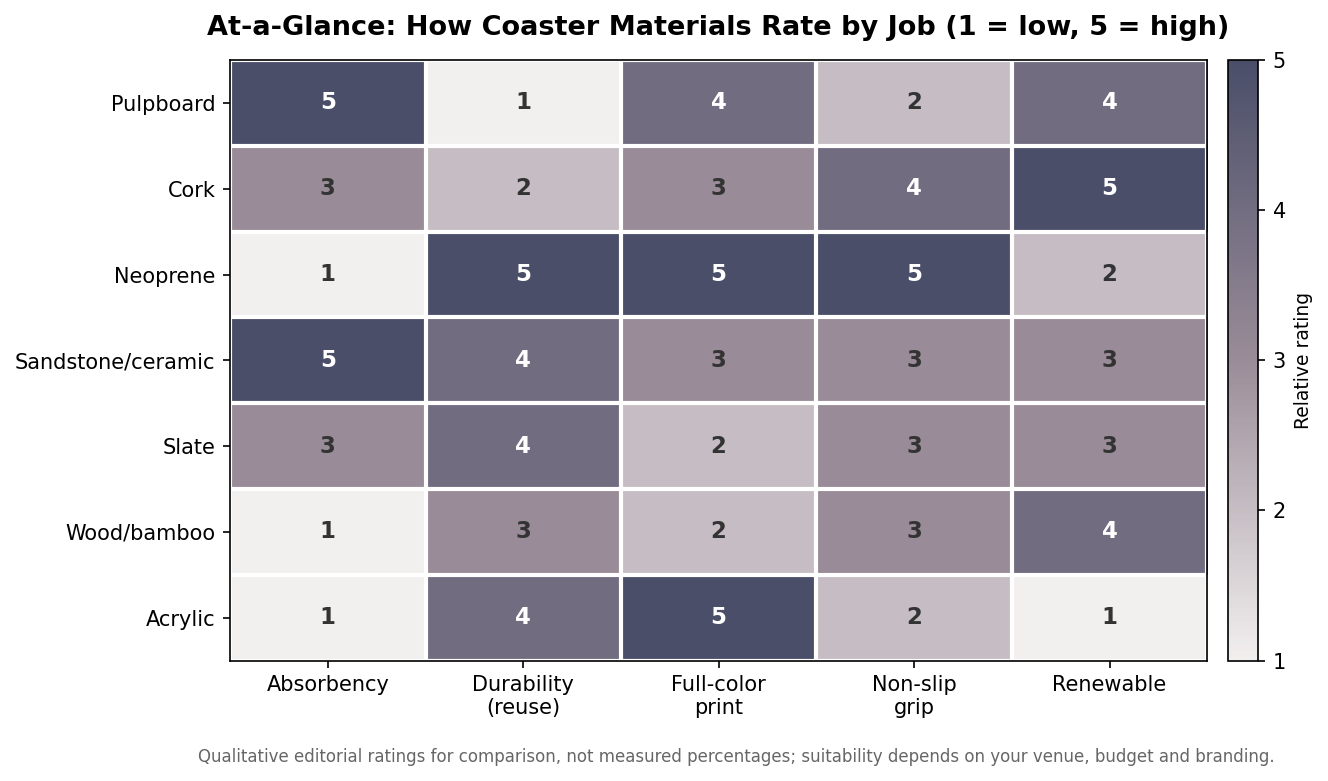
Read those ratings as an editorial starting point rather than a spec sheet, because the right pick always depends on your venue, budget and how the coaster is decorated. A few structural truths hold regardless. If you need absorbency, choose cork or natural stone and accept the weight or the shorter life that comes with each. If you need full-color logos and long service, neoprene is hard to beat. If the coaster is really a keepsake, let the material do the talking with slate, wood or acrylic and keep the graphics simple. And whatever you choose, order a printed sample and set a wet glass on it for an afternoon before committing to a few thousand pieces, because absorbency, grip and print durability are all far easier to judge in hand than on a screen.