The board gets most of the attention when people order custom bar coasters, but the print method decides more of what you actually get: how many colors you can run, how sharp the artwork looks, the smallest quantity a shop will accept, and the price per piece. A 4-inch pulpboard round can be produced four or five different ways, and the right one depends far more on your run size and artwork than on the coaster itself. Here is how the common methods differ and when each one is the sensible choice.
Offset (litho) printing is the workhorse for volume
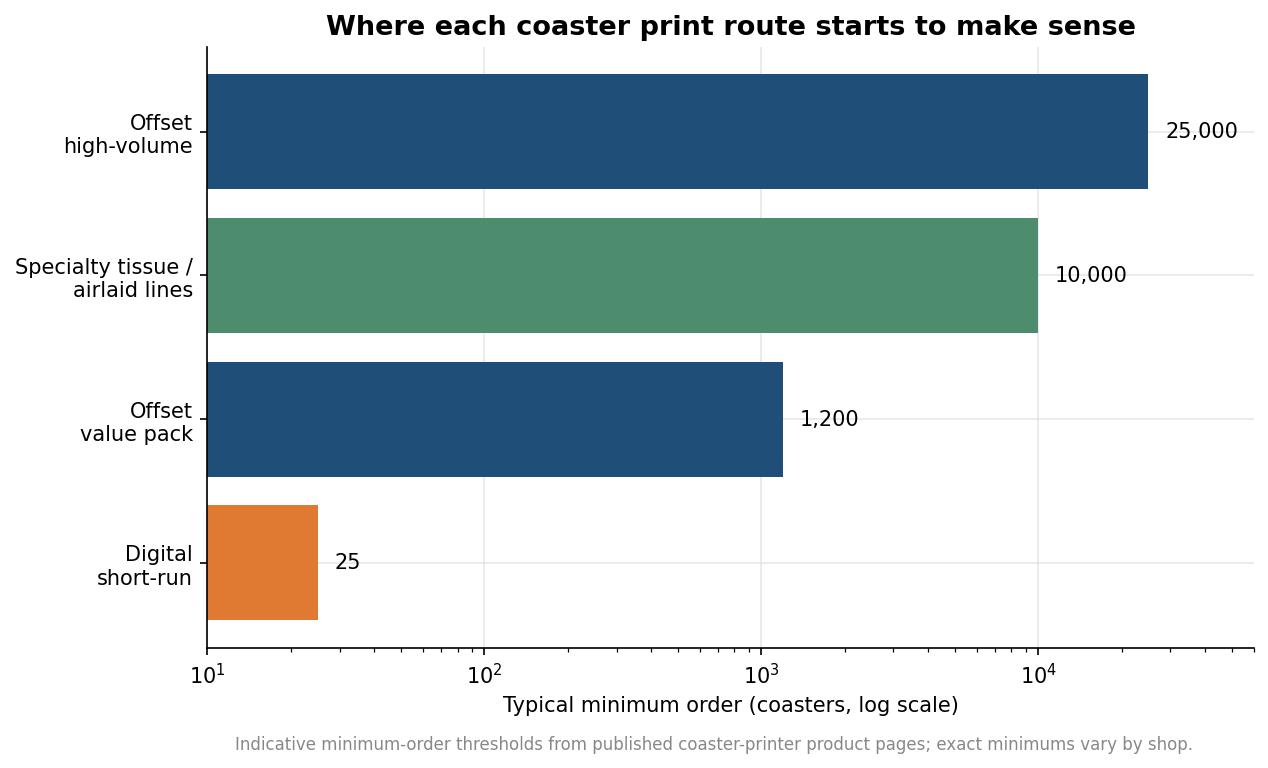
For most branded bar coasters, offset lithography is the default. It lays down a full CMYK process build for photographic artwork and supports PMS/Pantone spot colors when you need an exact brand match, and many coaster printers run vegetable-based inks on the absorbent pulpboard stock. The economics favor scale: offset carries plate and setup costs, so the per-coaster price keeps falling as the run grows. Published coaster lines commonly treat roughly 1,200 pieces as the entry point for a value run and scale cleanly into the tens of thousands and beyond, into the hundreds of thousands for national campaigns. If you are printing sharp full-color art in real quantity, offset is almost always the lowest cost per piece and the most consistent color across the run.
Digital printing wins the short run
When you need 25 to 500 coasters, digital is usually the only economical route. There are no plates to make, so the setup cost that makes offset expensive at low volumes largely disappears; short-run coaster products frequently start around 25 pieces, with entry pricing in the region of $25 for the smallest orders. Digital also handles photographic images and variable data well, so it suits event coasters, one-off wedding or party runs, prototypes you want to hold before committing to a big order, and versioned designs where each coaster carries a different name, table number, or QR code. The trade-off is per-unit cost: digital stays flat as quantity climbs, so somewhere in the low thousands offset overtakes it and becomes cheaper. The chart below shows roughly where each route tends to begin.
Letterpress, foil, and specialty finishes for a premium feel
If the coaster is meant to feel expensive, the decoration method matters more than the print resolution. Letterpress presses the design into the board for a tactile, debossed impression that reads as craft; foil stamping adds metallic or gloss highlights; and embossing raises elements without ink. These are typically spot treatments rather than full-color photographic printing, and they shine on heavier stocks and premium substrates. They also tend to carry higher minimums and cost more per piece, and some specialty substrates such as multi-ply tissue and airlaid coaster lines are quoted at minimums around 10,000 units. Reserve these methods for flagship venues, spirits brands, and hospitality settings where the coaster is part of the table experience rather than a giveaway.
How the board and the method have to match
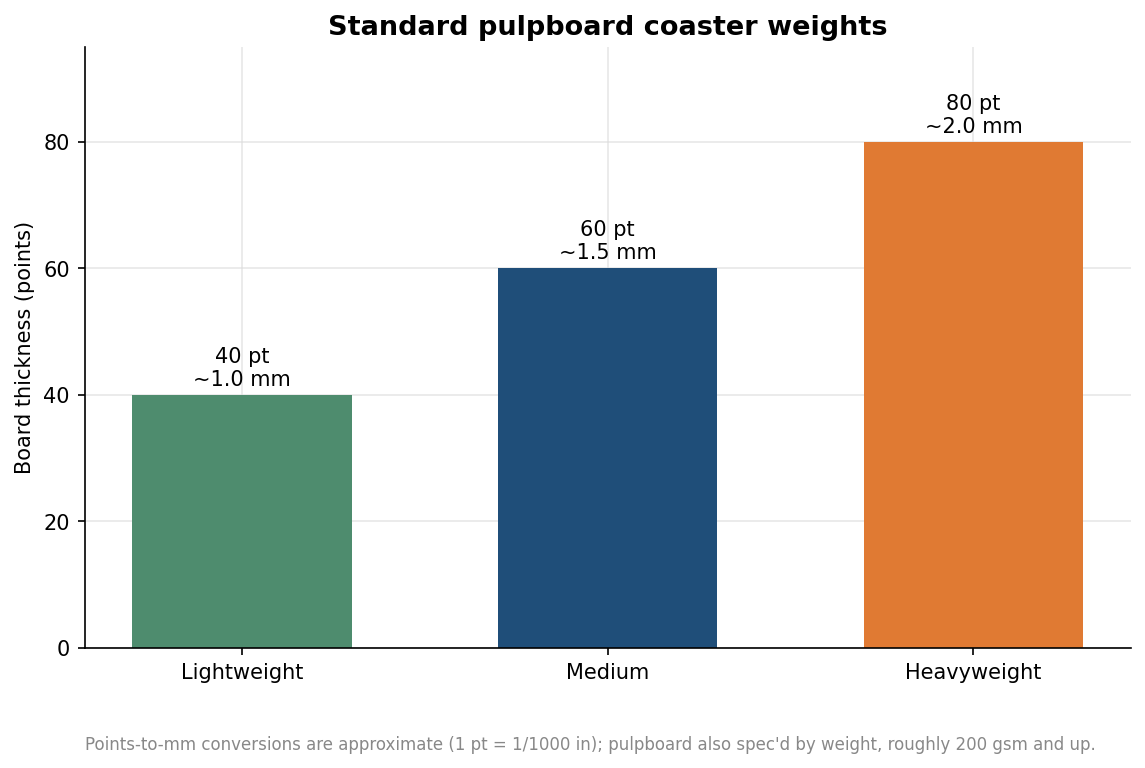
Print method and substrate are not independent choices. Standard pulpboard coaster stock comes in a few weights — commonly a lightweight board around 40 points (roughly 1 mm), a mid weight near 60 points, and a heavyweight near 80 points (roughly 2 mm) — and it is also specified by basis weight, with absorbent pulpboard often in the region of 200 gsm and up. Uncoated, absorbent board is what gives a beer mat its grip and its job of soaking up condensation, but that same porosity softens fine detail, so heavy small text and delicate gradients hold better on smoother or coated stocks. Absorbent paper coasters are offered in a range of weights from about 50 g to 200 g, and multi-ply tissue coasters run from 5-ply up to 12-ply for extra bulk and absorbency. Match the two: full-bleed photographic art on a smooth heavier board, simple bold branding on economical absorbent pulpboard, tactile treatments on premium stock.
Size, shape, and lead time still shape the quote
The last variables that move the price are format and timing. The most common bar coaster is a 4-inch round or square, with 3.5 inch a close second; custom shapes are available up to around 9 inches but require a cutting die, which adds a one-time tooling charge and a little lead time. On schedule, standard production varies by shop and quantity, and rush service is usually available at a premium — some printers publish expedited tiers around 7 to 10 business days with per-version surcharges. If your artwork uses a specific brand color, ask for a PMS match rather than a process build, confirm whether printing is one side or both, and request a physical proof on the actual stock before a large offset run, because absorbent board can shift color noticeably from what you see on screen. Get those four things right — method, stock, format, and proofing — and the coaster does its two jobs well: protect the surface and keep your brand in front of a drinker for the length of a pint.