Ordering custom coasters looks simple until you have to pick a stock, a size, and a print method that all match the way your venue actually pours drinks. A cocktail bar slinging iced drinks all night has different needs than a coffee shop, a brewery taproom, or a wedding planner ordering a one-night run of keepsakes. This guide walks through how to choose by venue and use case, so the coasters you receive do the job instead of curling, soaking through, or looking oversized under an espresso cup.
Start With How Wet the Drinks Are
Condensation is the single biggest driver of which coaster you should buy. Draft beer, iced cocktails, and anything served in a chilled glass sheds water fast, and thin stock saturates, softens, and loses its shape within a round or two. Thicker absorbent pulpboard holds more liquid and stays flat longer, which is why taprooms and cocktail bars lean toward the heavier grades. Coasters are typically specified in points, where one point equals one one-thousandth of an inch. Economy pulpboard runs around 35 pt, standard board sits near 40 to 45 pt, and heavy board reaches roughly 60 pt.
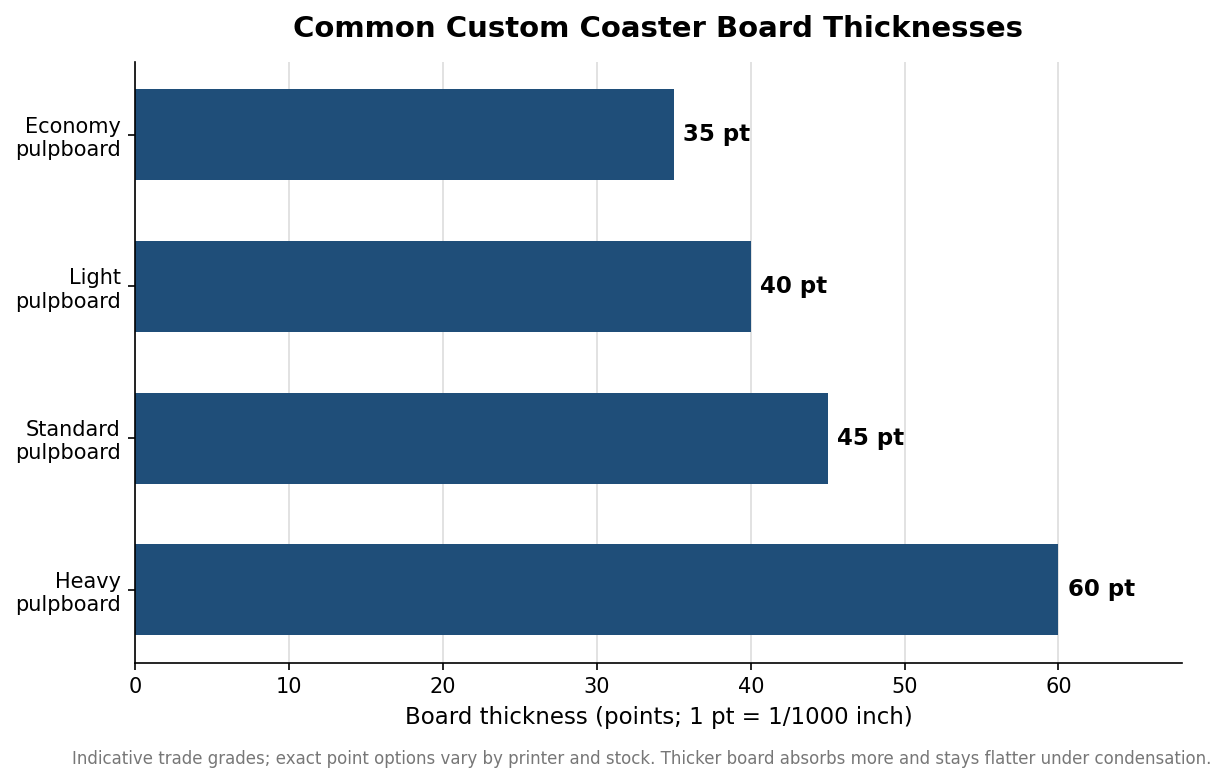
If your service is mostly hot drinks or room-temperature pours, absorbency matters far less and you can drop to a lighter, cheaper stock without regret. A coffee bar rarely needs 60 pt board because a cappuccino sweats very little. A brewery pouring cold pints all evening benefits from every extra point of thickness it can get. Match the stock to the wettest drink you serve regularly, not the average one, because the wettest drink is the one that fails a thin coaster.
Size the Coaster to the Glass, Not the Table
The all-purpose standard is 4 inches, offered as a 4-inch round or a 4-inch square, and it suits the widest range of glassware from pint glasses to wide-based rocks glasses and mugs. Smaller formats exist for a reason: a 3-inch round suits espresso and demitasse service, a roughly 3.375-inch round or square fits cup-and-saucer and cocktail use, and a 5-inch round works as a mat under pitchers and carafes. Round pulpboard commonly falls in the 3.5 to 4-inch range, while square coasters typically run 3.5 to 4 inches per side.
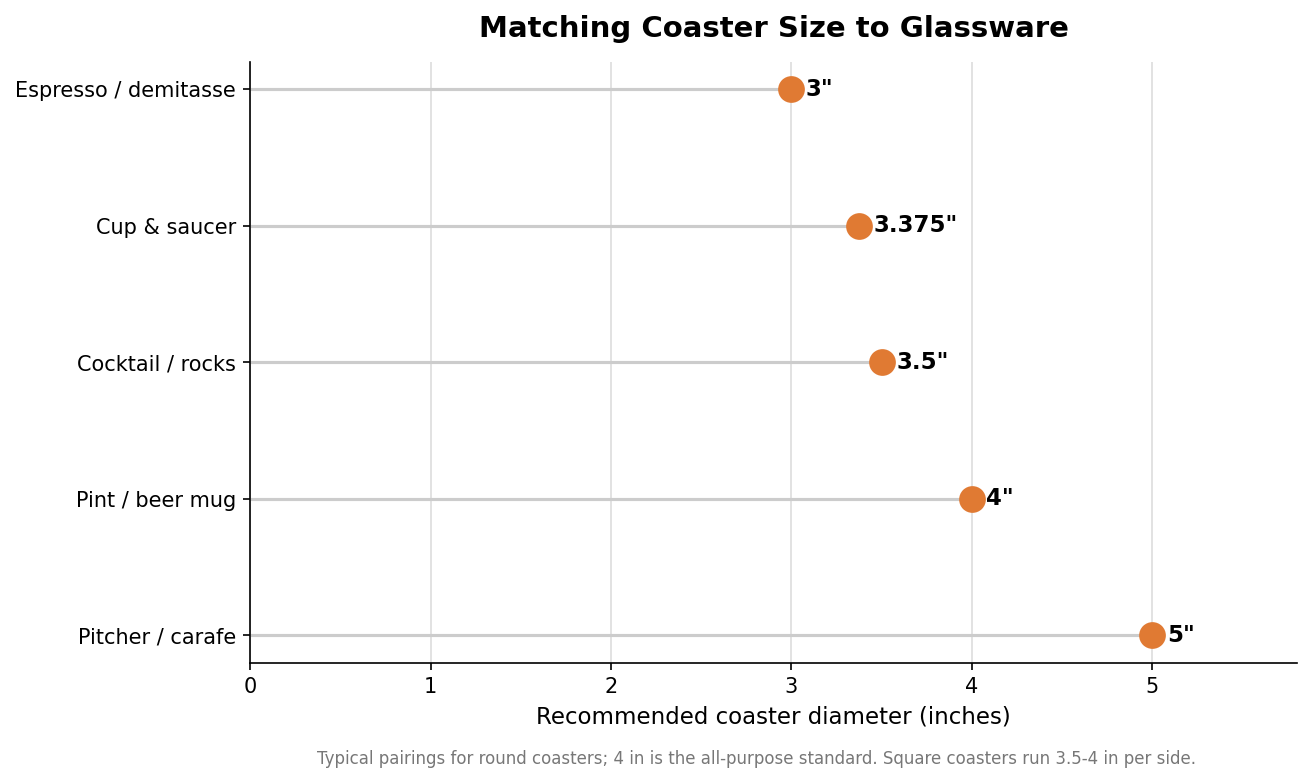
Oversizing is a common and avoidable mistake. A 5-inch coaster under an espresso cup looks like a placemat and wastes board you paid for, while a 3-inch coaster under a pint leaves the glass base hanging over the edge and dripping onto the bar. When in doubt, hold a sample glass over a printed sample coaster before committing to a full run. The base of the glass should sit comfortably inside the printed area with a small margin all around.
Choosing by Venue
Breweries and cocktail bars should default to heavier absorbent pulpboard in the 45 to 60 pt range, round or square 4-inch, because the volume of cold drinks and the pace of service punish anything thinner. These venues also replace coasters constantly, so buying disposable board in bulk is the sensible economics rather than trying to make each coaster last. Coffee shops and cafes can comfortably run lighter 35 to 40 pt stock in a 3.375 to 4-inch size, since hot drinks sweat little and the coaster is doing branding work more than moisture control.
Restaurants that want a more premium table presentation sometimes move away from disposable board entirely toward reusable materials like cork, accepting a higher per-piece cost in exchange for fewer replacements and a dressier look. That is a genuine tradeoff rather than an upgrade in every case: cork looks better on a set table but absorbs less aggressively and cannot be handed out as a promotional giveaway. Weddings and one-night events are the opposite calculation. Durability across months does not matter, so the decision is driven by appearance and quantity, and a mid-weight printed pulpboard coaster in a custom shape usually hits the mark at a reasonable cost.
Print Sides, Color, and Shape
Most pulpboard coasters print full color on one side, and many suppliers also offer two-sided printing, commonly one to four colors on the front and a single color on the back. The back of the coaster is genuinely useful real estate for a QR code, a drink menu, a hashtag, or an event date, and printing it typically adds only a modest amount to the unit cost. If your budget is tight, a strong single-sided design almost always beats a cramped two-sided one, so spend the ink where the glass is not sitting.
Shape is mostly an aesthetic and brand decision. Round and square are the standard, most economical options because they nest efficiently on press and require no special cutting. Custom die-cut shapes are available and can make a brand pop, but they add tooling and cost, so they make the most sense for larger runs where the setup is spread across more units. For a first order or a small event, a round or square coaster in a clean 4-inch format is the safe, cost-effective choice.
Quantity and Lead Time
Minimum order quantities vary widely. Some printers accept runs as low as 100 pieces, which suits a small event or a single-location test, while bulk pricing generally kicks in at 500 units and climbs from there, with the per-coaster cost dropping meaningfully as you scale into the thousands. High-volume venues that go through coasters nightly should plan around the larger tiers, because the unit economics reward it and you will use the inventory. As a rough planning figure, custom printed pulpboard coasters commonly land somewhere in the low tens of cents each, with heavier stock, two-sided printing, and die-cut shapes pushing toward the upper end; treat that as an indicative band and confirm exact pricing for your stock and quantity.
Lead time is worth confirming before you commit, especially for a dated event. Production and shipping windows differ by printer, and a wedding or a grand opening leaves no room for a reprint, so build in a buffer and order proofs early. The safest sequence is to lock the stock and size against the drinks you actually serve, approve a physical or digital proof, then place the full run with enough margin that a delay does not leave your bar without coasters on opening night.