Shape and size seem like the easy part of ordering bar coasters, right up until a proof comes back with the logo cramped into a circle that was never going to fit it. Getting these two decisions right early saves a reprint and usually saves money, because the format you pick drives the die, the minimum order, and how much usable print area you actually have. This guide walks through round versus square, the standard sizes worth defaulting to, thickness as a separate choice, and what a custom die-cut shape really costs.
Round or square: start with the glass and the brand
Round is the reflex, but square earns its place. A round coaster reads as the classic beer mat and centers a circular logo or a pint glass base neatly, which is why breweries and pubs lean toward it. A square or rectangular coaster gives you flat edges to align type against and noticeably more corner-to-corner print area for the same nominal size, which suits wordmarks, cocktail menus, and event details. The North American bar rectangle at 3.5 by 4 inches exists for exactly that reason: it holds more copy than a round of similar footprint. If your artwork is a tight circular emblem, go round; if it is a horizontal logo or carries text, a square almost always lays out better.
The standard sizes, and when to leave them
Most bar coasters cluster in a narrow band. Round coasters run from about 3 inches to 4 inches for drink service, with 3.5 inches (roughly 90 mm) and 4 inches (about 102 mm) doing most of the work; the wider 3-to-10-inch range only matters when you are sizing for pitchers or bowls rather than glasses. Square coasters standardize at 4 inches (10.2 cm), with 6 inches as a practical maximum before a coaster starts behaving like a placemat. The figure below lays the common sizes side by side so you can see how little separates them and where the outliers sit.
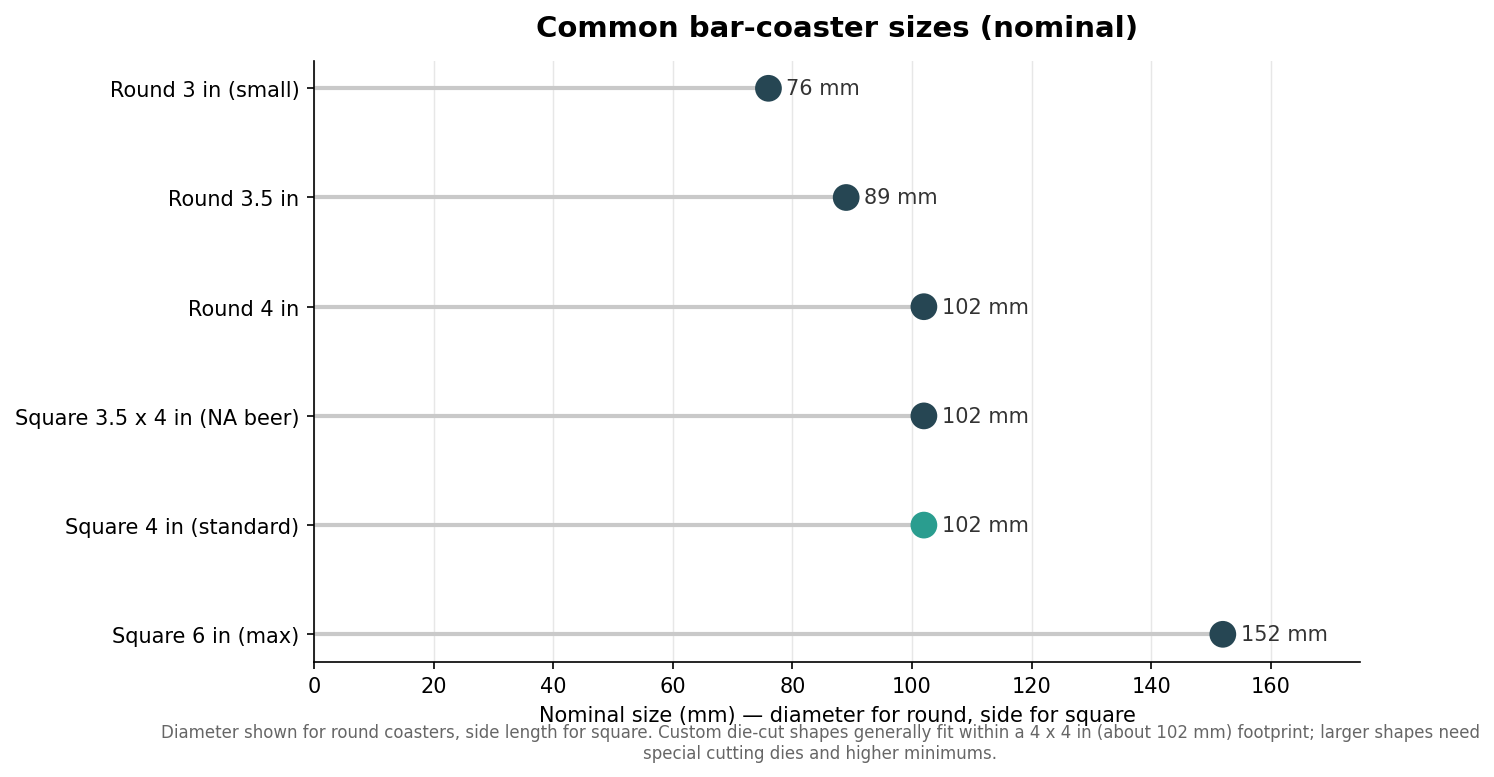
Default to a standard size unless you have a specific reason not to. Standard dies are already cut, so they carry lower minimums and faster turnarounds, and a 3.5-to-4-inch coaster comfortably fits the base of a pint, a rocks glass, or a stemless wine glass without crowding the table. Going oversized is worth it mainly when the coaster doubles as a menu, a tent-card base, or a promotional handout that has to carry more than a logo, and even then it is worth checking that your glassware does not simply slide around on a coaster far wider than the base it sits on.
Thickness is a separate decision from shape
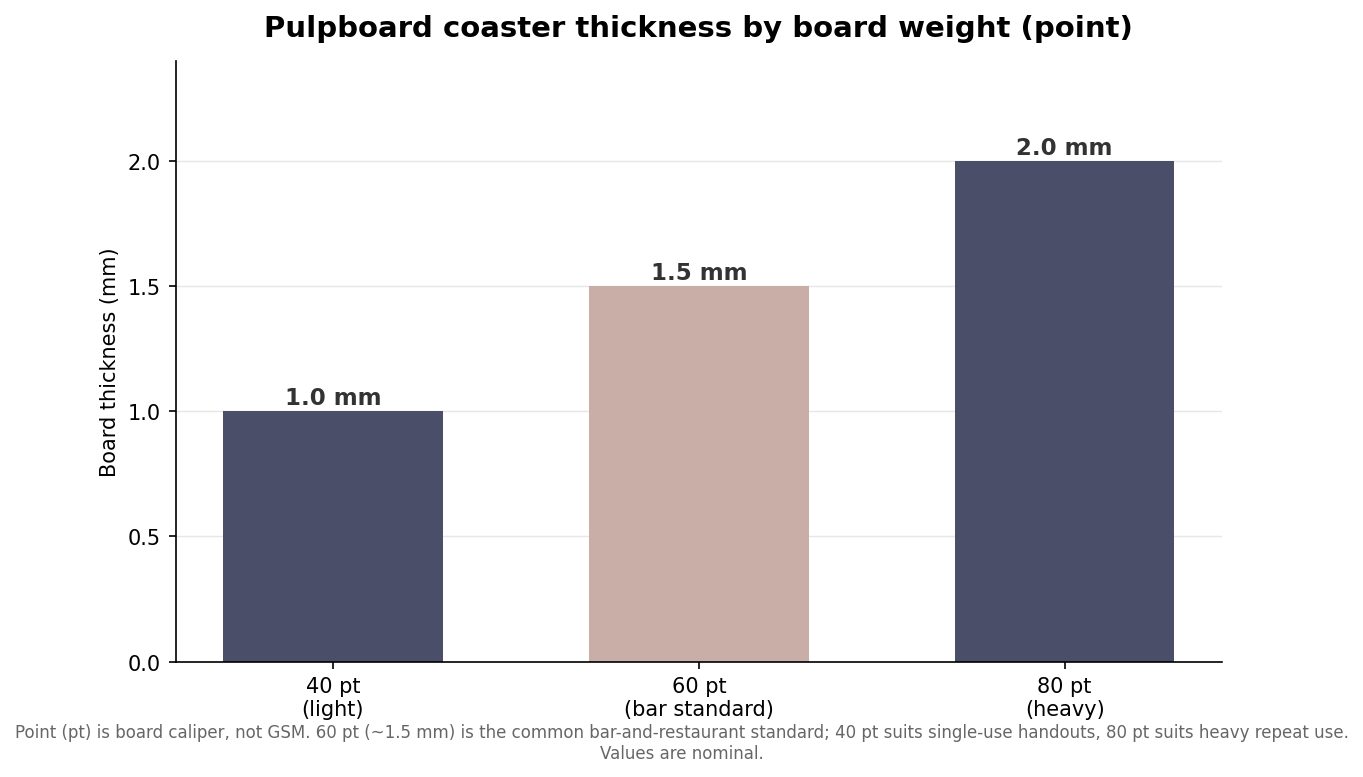
Board weight is measured in points, and it is easy to confuse with GSM. A point is board caliper, so a 40-point coaster is about 1 mm, a 60-point coaster about 1.5 mm, and an 80-point coaster about 2 mm. Sixty-point is the common bar-and-restaurant standard: thick enough to feel substantial and soak up condensation, without the cost of the heaviest stock. Forty-point suits high-volume single-use handouts where the coaster is essentially a printed giveaway, and 80-point earns its premium in settings where the same coaster gets picked up, set down, and wiped for a full shift. The chart shows the three tiers against their millimeter equivalents.
Thickness and absorbency travel together in pulpboard, sometimes called coasterboard: the same porous fiber that gives the board its bulk is what wicks away the ring of water under a cold glass. That is why a coated, glossy stock can look sharp and still perform badly on a bar, and why the absorbent matte face is the default for anything meant to sit under a drink.
Custom die-cut shapes: what they actually cost
Stepping outside round and square opens a long menu of preset dies, from hexagons and octagons to ovals, scalloped edges, shields, and shapes cut to echo a bottle, a ball, or a logo silhouette. The constraint is the footprint, not the imagination. Preset and custom shapes generally have to fit within a 4 by 4 inch envelope to run on standard tooling; go bigger and you move into special cutting dies with markedly higher minimums, often in the five-figure range of pieces. Die and tooling charges themselves vary by supplier. Some fold the cost of a stock preset shape into the unit price with no setup fee, while a genuinely bespoke silhouette usually carries a one-time tooling charge and a higher order minimum, since the die has to be made before the first coaster is cut.
Two practical cautions follow from this. Thin necks, sharp points, and fine cutouts survive better at 60-point or heavier, because a delicate shape in light board bends and tears at the register. And a custom die locks you into that shape for reorders, so it pays off when you are committing to a signature look across many thousands of coasters, not when you are testing a design for a single event.
Choosing for your venue
For a brewery or pub putting a round emblem in front of every pour, a 3.5-to-4-inch round in 60-point absorbent pulpboard is the safe, low-friction default. For a restaurant or cocktail bar with a horizontal wordmark or menu copy, a 4-inch square in the same weight gives you the layout room without a tooling bill. Save the custom die-cut for a brand that has settled on a signature shape and is ordering at the volume to justify the die, and keep any intricate outline in heavier board so it holds its edges. Decide shape and size before you brief the artwork, and the proof tends to come back right the first time.