Category: Uncategorized

  • How Custom Coasters Are Printed: Offset, Digital, Letterpress and Foil

    How Custom Coasters Are Printed: Offset, Digital, Letterpress and Foil

    The board gets most of the attention when people order custom bar coasters, but the print method decides more of what you actually get: how many colors you can run, how sharp the artwork looks, the smallest quantity a shop will accept, and the price per piece. A 4-inch pulpboard round can be produced four or five different ways, and the right one depends far more on your run size and artwork than on the coaster itself. Here is how the common methods differ and when each one is the sensible choice.

    Offset (litho) printing is the workhorse for volume

    For most branded bar coasters, offset lithography is the default. It lays down a full CMYK process build for photographic artwork and supports PMS/Pantone spot colors when you need an exact brand match, and many coaster printers run vegetable-based inks on the absorbent pulpboard stock. The economics favor scale: offset carries plate and setup costs, so the per-coaster price keeps falling as the run grows. Published coaster lines commonly treat roughly 1,200 pieces as the entry point for a value run and scale cleanly into the tens of thousands and beyond, into the hundreds of thousands for national campaigns. If you are printing sharp full-color art in real quantity, offset is almost always the lowest cost per piece and the most consistent color across the run.

    Digital printing wins the short run

    When you need 25 to 500 coasters, digital is usually the only economical route. There are no plates to make, so the setup cost that makes offset expensive at low volumes largely disappears; short-run coaster products frequently start around 25 pieces, with entry pricing in the region of $25 for the smallest orders. Digital also handles photographic images and variable data well, so it suits event coasters, one-off wedding or party runs, prototypes you want to hold before committing to a big order, and versioned designs where each coaster carries a different name, table number, or QR code. The trade-off is per-unit cost: digital stays flat as quantity climbs, so somewhere in the low thousands offset overtakes it and becomes cheaper. The chart below shows roughly where each route tends to begin.
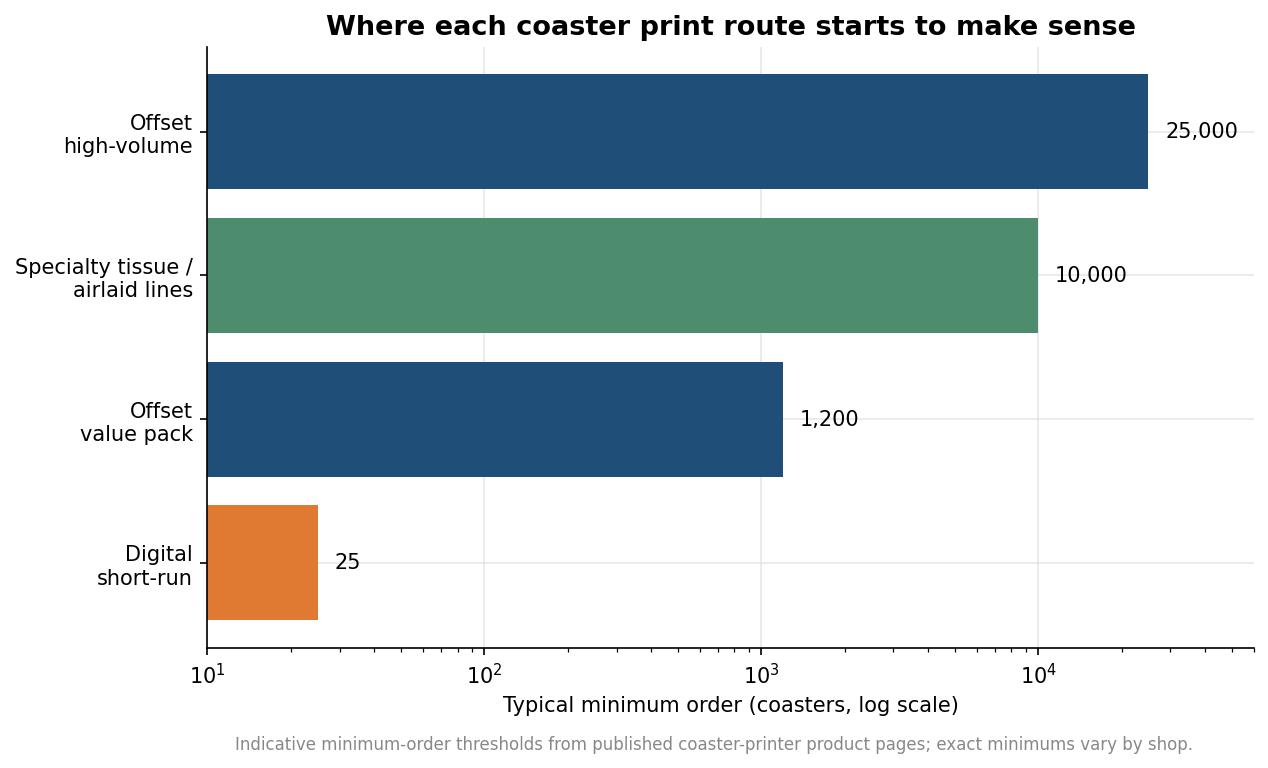
    Horizontal bar chart of typical minimum order quantities by coaster print route, from 25 for digital short-run to 25,000 for high-volume offset
    Digital covers the smallest runs; offset takes over as quantities climb into the thousands.

    Letterpress, foil, and specialty finishes for a premium feel

    If the coaster is meant to feel expensive, the decoration method matters more than the print resolution. Letterpress presses the design into the board for a tactile, debossed impression that reads as craft; foil stamping adds metallic or gloss highlights; and embossing raises elements without ink. These are typically spot treatments rather than full-color photographic printing, and they shine on heavier stocks and premium substrates. They also tend to carry higher minimums and cost more per piece, and some specialty substrates such as multi-ply tissue and airlaid coaster lines are quoted at minimums around 10,000 units. Reserve these methods for flagship venues, spirits brands, and hospitality settings where the coaster is part of the table experience rather than a giveaway.

    How the board and the method have to match

    Print method and substrate are not independent choices. Standard pulpboard coaster stock comes in a few weights — commonly a lightweight board around 40 points (roughly 1 mm), a mid weight near 60 points, and a heavyweight near 80 points (roughly 2 mm) — and it is also specified by basis weight, with absorbent pulpboard often in the region of 200 gsm and up. Uncoated, absorbent board is what gives a beer mat its grip and its job of soaking up condensation, but that same porosity softens fine detail, so heavy small text and delicate gradients hold better on smoother or coated stocks. Absorbent paper coasters are offered in a range of weights from about 50 g to 200 g, and multi-ply tissue coasters run from 5-ply up to 12-ply for extra bulk and absorbency. Match the two: full-bleed photographic art on a smooth heavier board, simple bold branding on economical absorbent pulpboard, tactile treatments on premium stock.
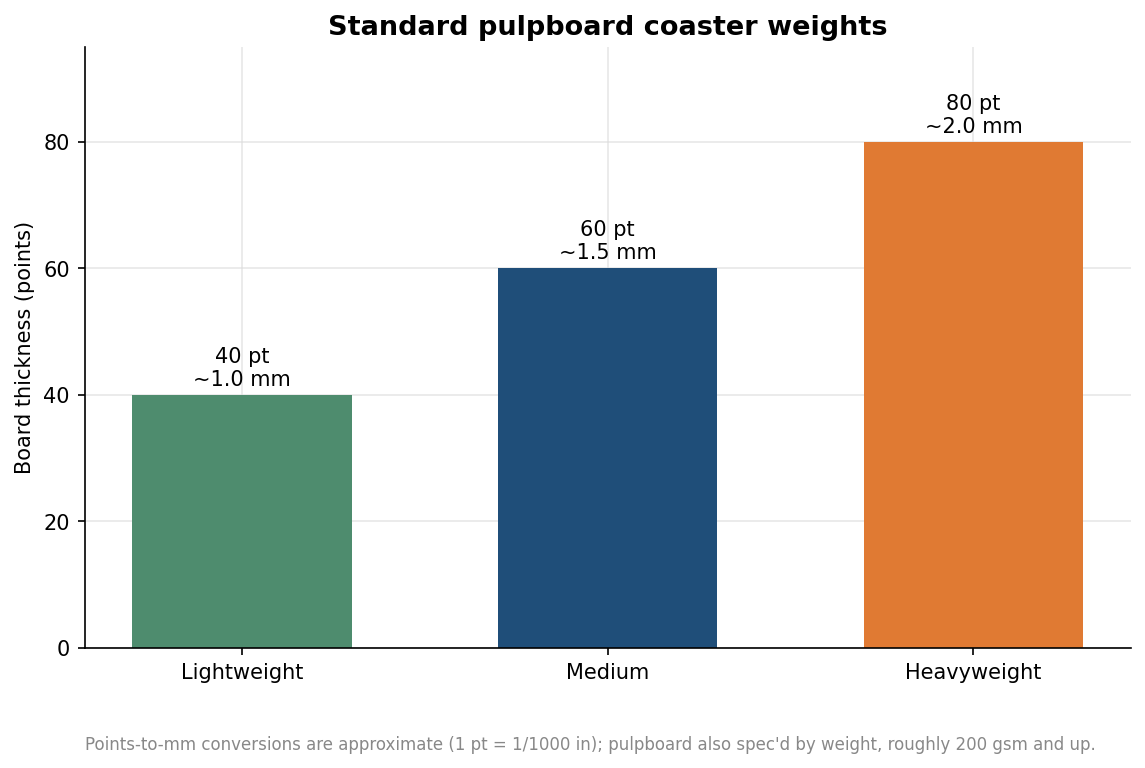
    Bar chart of standard pulpboard coaster weights: lightweight 40 point, medium 60 point, heavyweight 80 point
    Standard pulpboard weights, in points with approximate millimeter equivalents.

    Size, shape, and lead time still shape the quote

    The last variables that move the price are format and timing. The most common bar coaster is a 4-inch round or square, with 3.5 inch a close second; custom shapes are available up to around 9 inches but require a cutting die, which adds a one-time tooling charge and a little lead time. On schedule, standard production varies by shop and quantity, and rush service is usually available at a premium — some printers publish expedited tiers around 7 to 10 business days with per-version surcharges. If your artwork uses a specific brand color, ask for a PMS match rather than a process build, confirm whether printing is one side or both, and request a physical proof on the actual stock before a large offset run, because absorbent board can shift color noticeably from what you see on screen. Get those four things right — method, stock, format, and proofing — and the coaster does its two jobs well: protect the surface and keep your brand in front of a drinker for the length of a pint.
  • Reusable Coaster Materials Compared: Cork, Neoprene, Stone, Wood and Acrylic

    Reusable Coaster Materials Compared: Cork, Neoprene, Stone, Wood and Acrylic

    Disposable pulpboard is the right answer for a busy bar, but it is not the only coaster a brand orders. Breweries selling merch, hotels dressing a lobby bar, real estate offices assembling closing gifts, and event planners building welcome kits all reach for reusable coasters, and there the material choice gets more interesting. Cork, neoprene, sandstone, ceramic, slate, wood and acrylic each behave differently in the two ways that matter most: how they deal with a sweating glass, and how well they carry your artwork. This guide walks through the reusable options with the specifics that separate a coaster people keep from one that warps, slides, or prints muddy.

    The first fork: absorb the condensation, or wipe it away

    Every reusable coaster answers the condensation problem in one of two ways. Absorbent materials, such as cork and natural stone, pull the moisture into the coaster and let it evaporate between uses. Closed-cell and sealed materials, such as neoprene, acrylic and glazed ceramic, do not soak anything up; they simply keep the ring off the furniture and get wiped down. Neither approach is better in the abstract, but they fail differently. An absorbent coaster left permanently wet can grow musty, while a non-absorbent one can let a puddle slide the glass around. Decide which behavior your setting wants before you shop on looks.

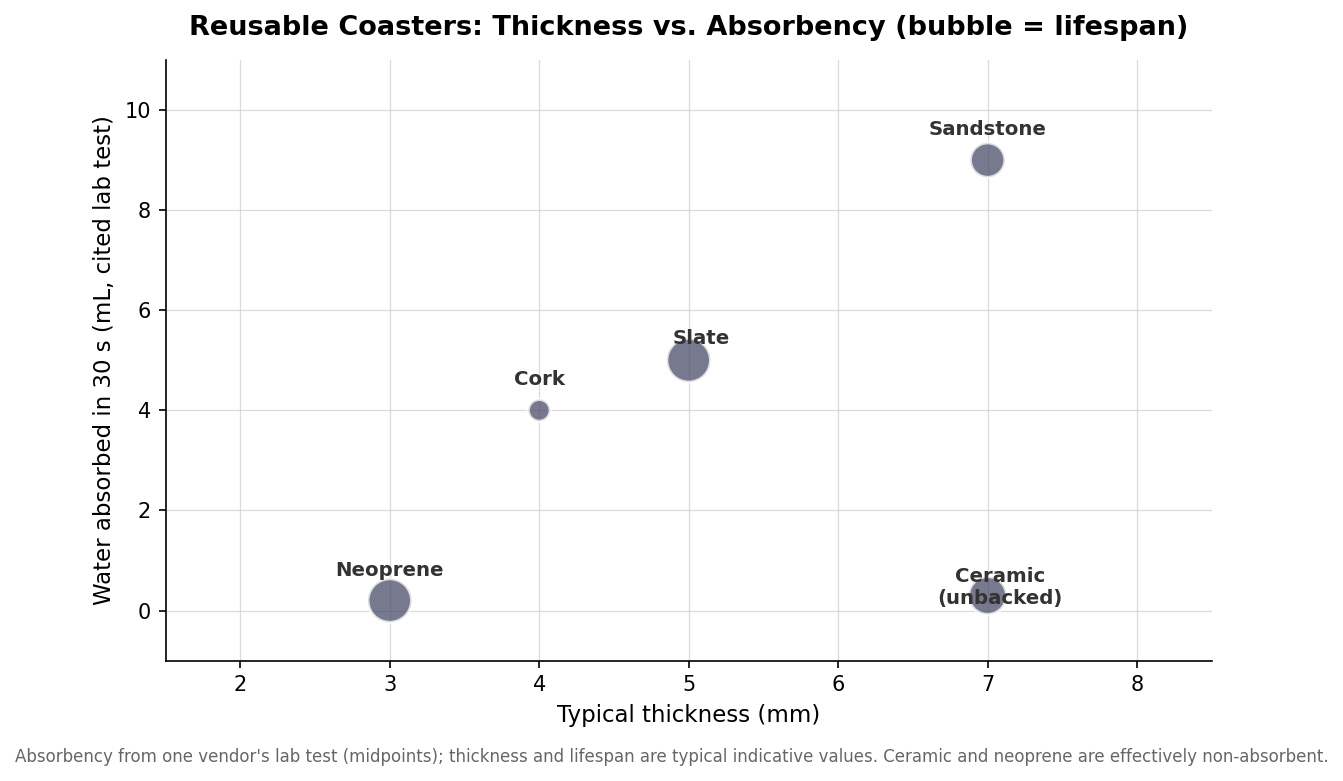
    The numbers make the split concrete. In one vendor’s lab testing, sandstone absorbed roughly 8 to 10 milliliters of water in 30 seconds and slate 4 to 6, while cork took up about 3 to 5. Neoprene and unbacked ceramic, by contrast, absorbed essentially nothing. The scatter below plots that absorbency against typical thickness, with bubble size standing in for how many years each material tends to last.

    Bubble scatter chart of reusable coaster materials plotting typical thickness against water absorbed in 30 seconds
    Sandstone leads on absorbency, neoprene and ceramic absorb almost nothing, and bubble size reflects typical lifespan.

    The absorbent camp: cork, sandstone and ceramic

    Cork is the workhorse of reusable absorbent coasters. At a typical 3 to 5 millimeters thick it is light, naturally grippy, renewable, and cheap, and it takes screen, UV and laser decoration well. The tradeoff is lifespan: cork is often cited at roughly one to three years of real use before the edges crumble and stains set in, so it suits promotional runs and giveaways more than permanent barware.

    Natural stone is the absorbency champion. Sandstone and similar porous stone wick condensation fast, which is exactly why the well-known absorbent-stone coasters use it. The catches are weight and fragility, since stone is thick, around six to eight millimeters, heavy in a stack, and prone to chipping if dropped, and it needs a cork or rubber backing to protect the table and add grip. Decoration is usually a dye or ceramic-style transfer, which handles logos and full-color art but with slightly softer edges than a printed surface.

    Ceramic is the confusing one, because most glazed ceramic is not absorbent at all; the glaze seals the surface. Only unglazed or specially bisque-fired ceramic drinks anything in, and even then makers usually add a cork base. What ceramic does offer is a hard, printable face with a genuinely long life, commonly five to seven years, and support for screen and transfer printing. If a supplier calls a glossy ceramic coaster absorbent, ask whether the drinking side is actually unsealed.

    The wipe-clean camp: neoprene and acrylic

    Neoprene has become the default for full-color branded coasters, and the reason is durability plus print range. The fabric top takes dye-sublimation printing, so photographs, gradients and complex logos all reproduce cleanly, and the closed-cell foam gives excellent non-slip grip. In the same lab testing referenced above, neoprene coasters were reported to survive more than a thousand wash cycles without losing shape or print, outlasting cork by roughly fourfold, and they are typically dishwasher-safe and resistant to mold and odor. At about three millimeters thick they are non-absorbent by design, functioning by keeping the ring off the surface rather than soaking it up, which is a fine tradeoff for anyone who would rather wipe a coaster than dry it.

    Acrylic sits at the premium, display end. It is non-absorbent, rigid, and takes vivid printing, often with the art on the underside so the glossy top protects it, which makes it a favorite for upscale bars and retail. The downsides are that it offers little grip unless it has rubber feet, it scratches, and it is the least eco-friendly option here. Reserve it for looks-forward settings rather than high-volume service.

    Slate, wood and the look-first materials

    Slate and wood are chosen for their appearance first and their function second. Slate reads upscale and rustic, is moderately absorbent at roughly four to six milliliters in the same testing, and is durable, but it is heavy and generally limited to laser-engraved or single-color branding rather than full color. Wood and bamboo look warm and are renewable, but bare wood barely absorbs and can stain or swell unless it is sealed, and like slate it is best decorated by laser engraving, which means a tone-on-tone mark rather than a colorful print. Both are excellent for gift and retail coasters where the material itself is part of the message, and weaker choices where spill control or vivid color is the priority.

    Matching the material to the job

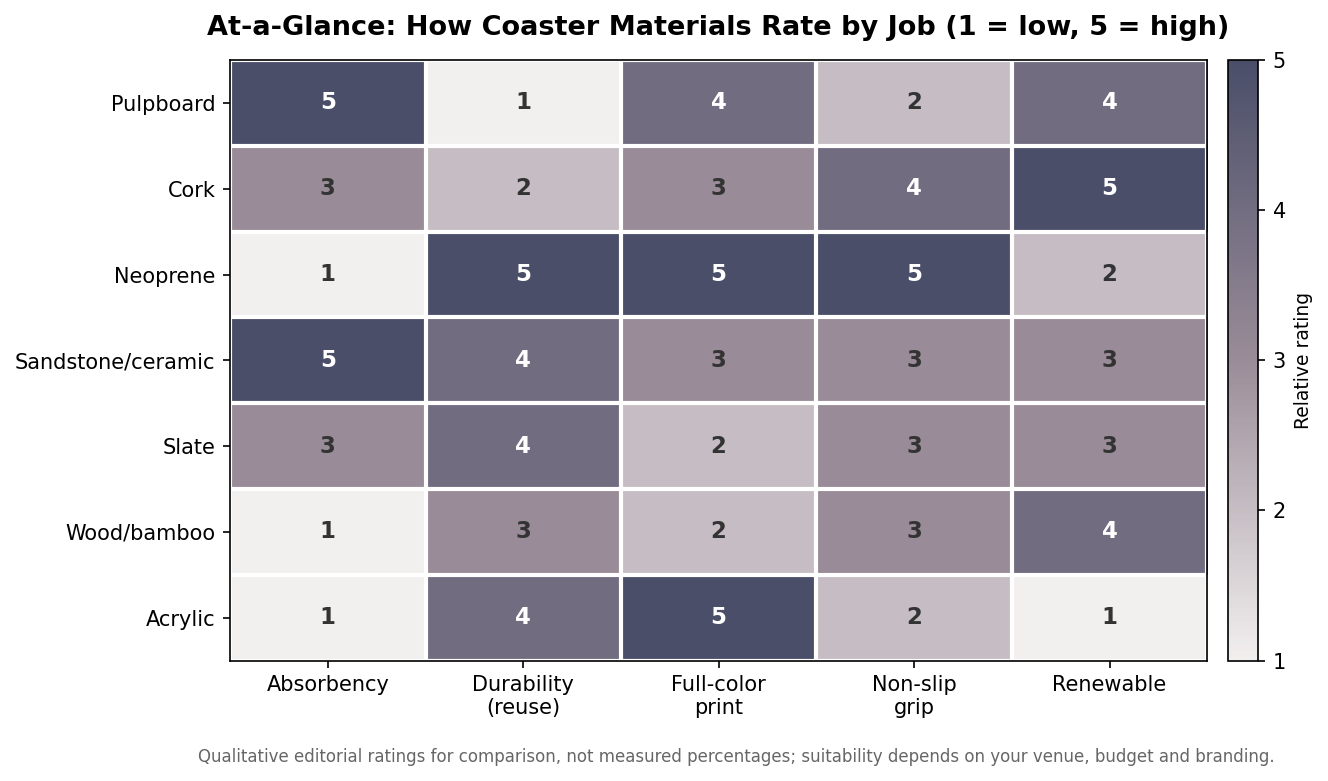
    Because no single material wins on everything, the practical move is to rank the two or three attributes that matter for your use and pick accordingly. A brewery tasting room that wants photographic label art and daily washing leans neoprene. A boutique hotel bar that wants condensation actually absorbed leans sandstone or cork. A closing gift that should look expensive on a desk leans slate, wood or acrylic. The matrix below rates each material across the jobs a coaster is usually asked to do.

    Heatmap rating seven coaster materials across absorbency, durability, full-color print, non-slip grip and renewability
    No material wins everything: rank the two or three attributes your venue needs, then read across the row.

    Read those ratings as an editorial starting point rather than a spec sheet, because the right pick always depends on your venue, budget and how the coaster is decorated. A few structural truths hold regardless. If you need absorbency, choose cork or natural stone and accept the weight or the shorter life that comes with each. If you need full-color logos and long service, neoprene is hard to beat. If the coaster is really a keepsake, let the material do the talking with slate, wood or acrylic and keep the graphics simple. And whatever you choose, order a printed sample and set a wet glass on it for an afternoon before committing to a few thousand pieces, because absorbency, grip and print durability are all far easier to judge in hand than on a screen.

  • Bar Coaster Shapes and Sizes: Round, Square, and Custom Die-Cut

    Bar Coaster Shapes and Sizes: Round, Square, and Custom Die-Cut

    Shape and size seem like the easy part of ordering bar coasters, right up until a proof comes back with the logo cramped into a circle that was never going to fit it. Getting these two decisions right early saves a reprint and usually saves money, because the format you pick drives the die, the minimum order, and how much usable print area you actually have. This guide walks through round versus square, the standard sizes worth defaulting to, thickness as a separate choice, and what a custom die-cut shape really costs.

    Round or square: start with the glass and the brand

    Round is the reflex, but square earns its place. A round coaster reads as the classic beer mat and centers a circular logo or a pint glass base neatly, which is why breweries and pubs lean toward it. A square or rectangular coaster gives you flat edges to align type against and noticeably more corner-to-corner print area for the same nominal size, which suits wordmarks, cocktail menus, and event details. The North American bar rectangle at 3.5 by 4 inches exists for exactly that reason: it holds more copy than a round of similar footprint. If your artwork is a tight circular emblem, go round; if it is a horizontal logo or carries text, a square almost always lays out better.

    The standard sizes, and when to leave them

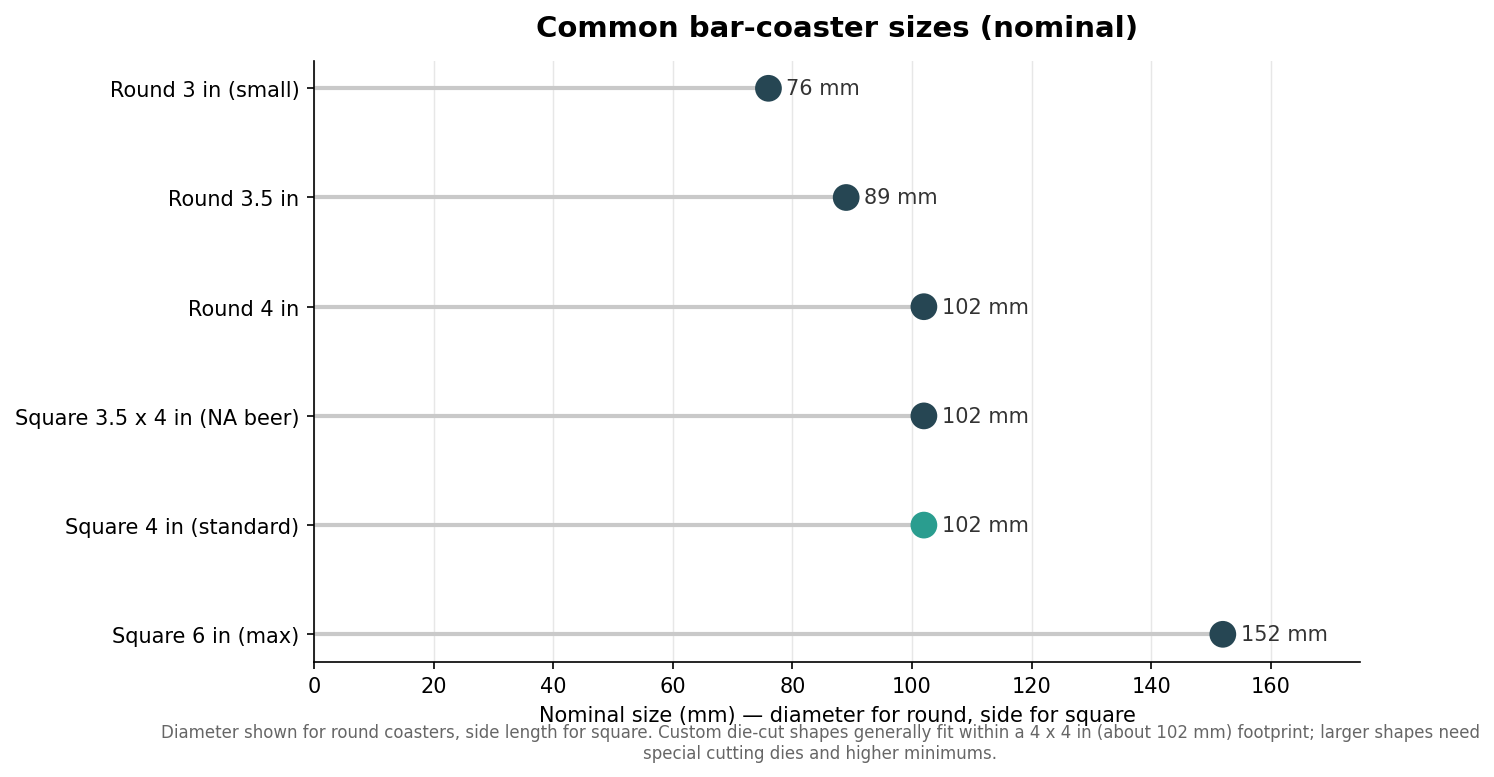
    Most bar coasters cluster in a narrow band. Round coasters run from about 3 inches to 4 inches for drink service, with 3.5 inches (roughly 90 mm) and 4 inches (about 102 mm) doing most of the work; the wider 3-to-10-inch range only matters when you are sizing for pitchers or bowls rather than glasses. Square coasters standardize at 4 inches (10.2 cm), with 6 inches as a practical maximum before a coaster starts behaving like a placemat. The figure below lays the common sizes side by side so you can see how little separates them and where the outliers sit.

    Dot plot of common bar coaster sizes in millimeters, round diameters and square side lengths
    Common coaster sizes cluster near 90 to 102 mm; 6-inch squares and 3-inch rounds are the outliers.

    Default to a standard size unless you have a specific reason not to. Standard dies are already cut, so they carry lower minimums and faster turnarounds, and a 3.5-to-4-inch coaster comfortably fits the base of a pint, a rocks glass, or a stemless wine glass without crowding the table. Going oversized is worth it mainly when the coaster doubles as a menu, a tent-card base, or a promotional handout that has to carry more than a logo, and even then it is worth checking that your glassware does not simply slide around on a coaster far wider than the base it sits on.

    Thickness is a separate decision from shape

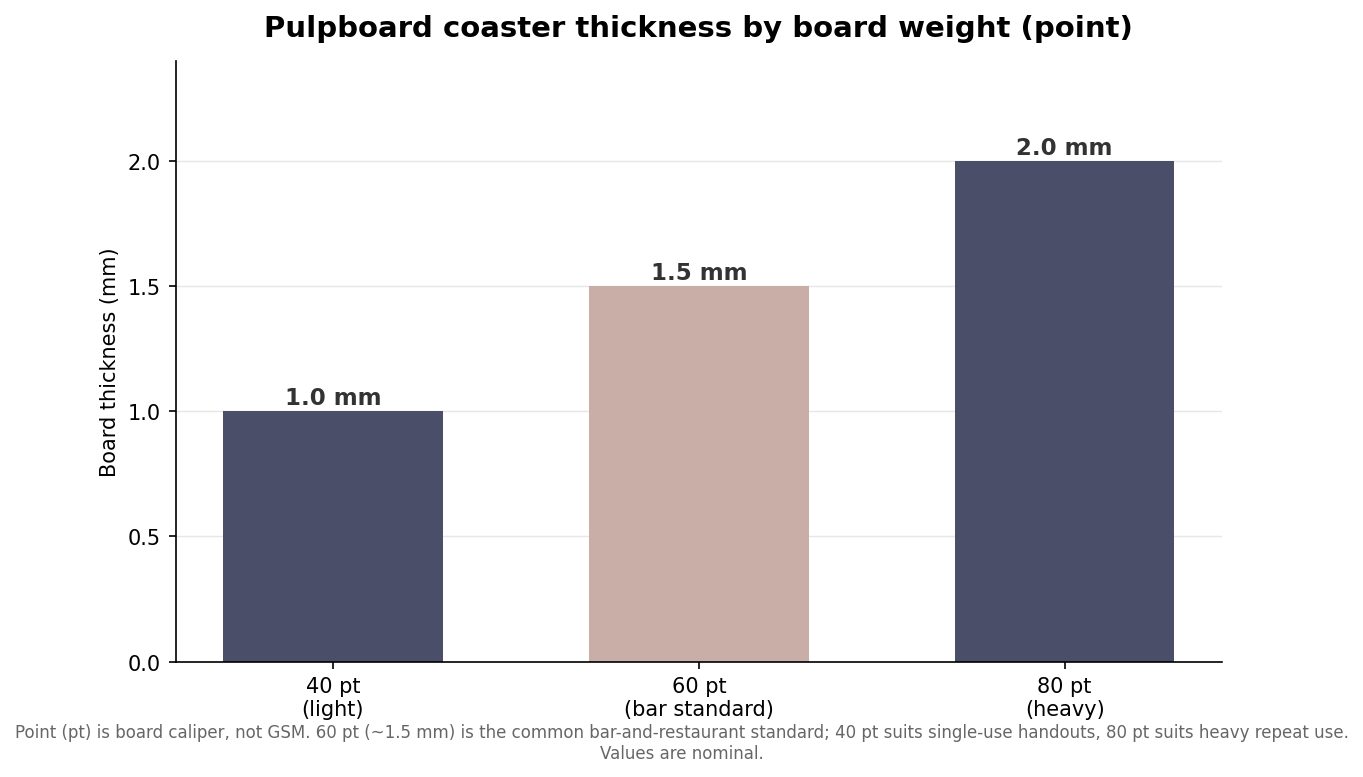
    Board weight is measured in points, and it is easy to confuse with GSM. A point is board caliper, so a 40-point coaster is about 1 mm, a 60-point coaster about 1.5 mm, and an 80-point coaster about 2 mm. Sixty-point is the common bar-and-restaurant standard: thick enough to feel substantial and soak up condensation, without the cost of the heaviest stock. Forty-point suits high-volume single-use handouts where the coaster is essentially a printed giveaway, and 80-point earns its premium in settings where the same coaster gets picked up, set down, and wiped for a full shift. The chart shows the three tiers against their millimeter equivalents.

    Bar chart of pulpboard coaster thickness by board point: 40pt 1mm, 60pt 1.5mm bar standard, 80pt 2mm
    Board weight in points versus thickness; 60-point (about 1.5 mm) is the usual bar-and-restaurant standard.

    Thickness and absorbency travel together in pulpboard, sometimes called coasterboard: the same porous fiber that gives the board its bulk is what wicks away the ring of water under a cold glass. That is why a coated, glossy stock can look sharp and still perform badly on a bar, and why the absorbent matte face is the default for anything meant to sit under a drink.

    Custom die-cut shapes: what they actually cost

    Stepping outside round and square opens a long menu of preset dies, from hexagons and octagons to ovals, scalloped edges, shields, and shapes cut to echo a bottle, a ball, or a logo silhouette. The constraint is the footprint, not the imagination. Preset and custom shapes generally have to fit within a 4 by 4 inch envelope to run on standard tooling; go bigger and you move into special cutting dies with markedly higher minimums, often in the five-figure range of pieces. Die and tooling charges themselves vary by supplier. Some fold the cost of a stock preset shape into the unit price with no setup fee, while a genuinely bespoke silhouette usually carries a one-time tooling charge and a higher order minimum, since the die has to be made before the first coaster is cut.

    Two practical cautions follow from this. Thin necks, sharp points, and fine cutouts survive better at 60-point or heavier, because a delicate shape in light board bends and tears at the register. And a custom die locks you into that shape for reorders, so it pays off when you are committing to a signature look across many thousands of coasters, not when you are testing a design for a single event.

    Choosing for your venue

    For a brewery or pub putting a round emblem in front of every pour, a 3.5-to-4-inch round in 60-point absorbent pulpboard is the safe, low-friction default. For a restaurant or cocktail bar with a horizontal wordmark or menu copy, a 4-inch square in the same weight gives you the layout room without a tooling bill. Save the custom die-cut for a brand that has settled on a signature shape and is ordering at the volume to justify the die, and keep any intricate outline in heavier board so it holds its edges. Decide shape and size before you brief the artwork, and the proof tends to come back right the first time.

  • How to Choose Custom Coasters by Venue: Bars, Breweries, Cafes, and Events

    How to Choose Custom Coasters by Venue: Bars, Breweries, Cafes, and Events

    Ordering custom coasters looks simple until you have to pick a stock, a size, and a print method that all match the way your venue actually pours drinks. A cocktail bar slinging iced drinks all night has different needs than a coffee shop, a brewery taproom, or a wedding planner ordering a one-night run of keepsakes. This guide walks through how to choose by venue and use case, so the coasters you receive do the job instead of curling, soaking through, or looking oversized under an espresso cup.

    Start With How Wet the Drinks Are

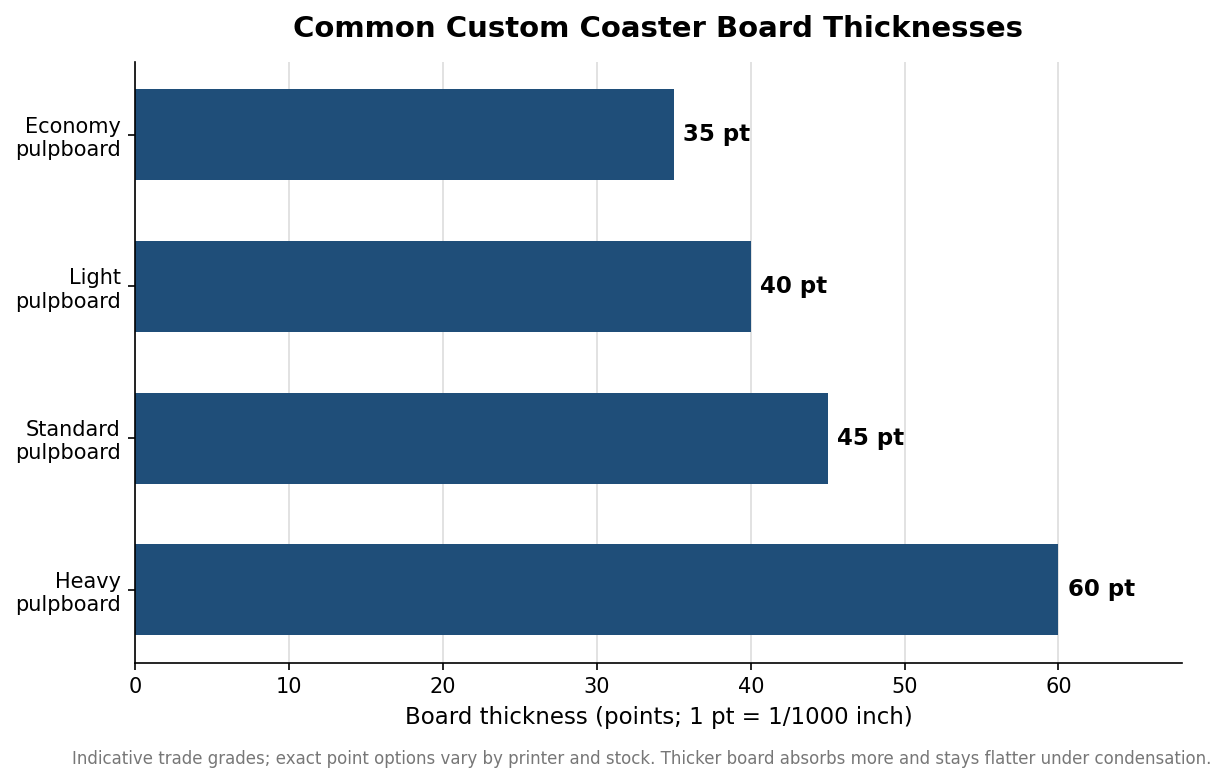
    Condensation is the single biggest driver of which coaster you should buy. Draft beer, iced cocktails, and anything served in a chilled glass sheds water fast, and thin stock saturates, softens, and loses its shape within a round or two. Thicker absorbent pulpboard holds more liquid and stays flat longer, which is why taprooms and cocktail bars lean toward the heavier grades. Coasters are typically specified in points, where one point equals one one-thousandth of an inch. Economy pulpboard runs around 35 pt, standard board sits near 40 to 45 pt, and heavy board reaches roughly 60 pt.

    Horizontal bar chart of common custom coaster board thicknesses from 35 to 60 points
    Coaster board is sold in points; heavier grades absorb more and resist curling under condensation.

    If your service is mostly hot drinks or room-temperature pours, absorbency matters far less and you can drop to a lighter, cheaper stock without regret. A coffee bar rarely needs 60 pt board because a cappuccino sweats very little. A brewery pouring cold pints all evening benefits from every extra point of thickness it can get. Match the stock to the wettest drink you serve regularly, not the average one, because the wettest drink is the one that fails a thin coaster.

    Size the Coaster to the Glass, Not the Table

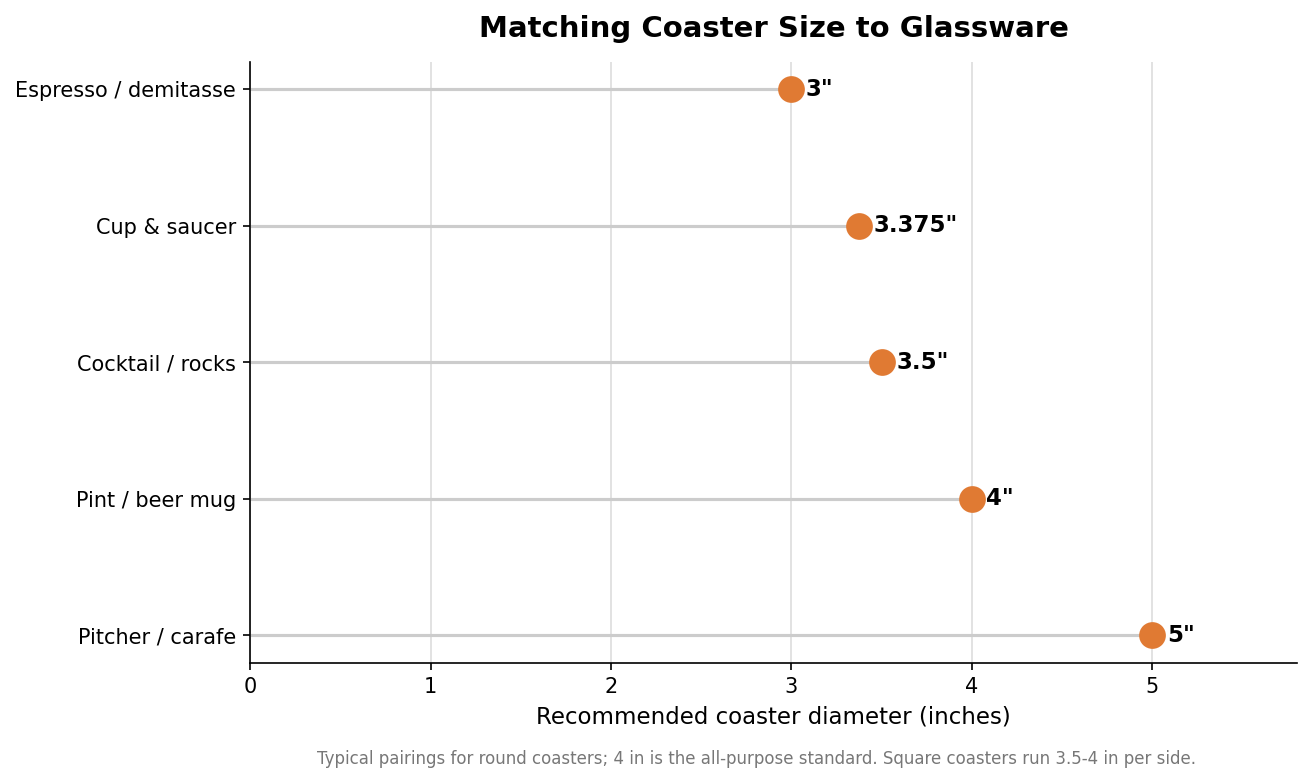
    The all-purpose standard is 4 inches, offered as a 4-inch round or a 4-inch square, and it suits the widest range of glassware from pint glasses to wide-based rocks glasses and mugs. Smaller formats exist for a reason: a 3-inch round suits espresso and demitasse service, a roughly 3.375-inch round or square fits cup-and-saucer and cocktail use, and a 5-inch round works as a mat under pitchers and carafes. Round pulpboard commonly falls in the 3.5 to 4-inch range, while square coasters typically run 3.5 to 4 inches per side.

    Dot plot matching recommended coaster diameter in inches to different glassware types
    Match coaster diameter to the glass base; 4 inches is the all-purpose standard.

    Oversizing is a common and avoidable mistake. A 5-inch coaster under an espresso cup looks like a placemat and wastes board you paid for, while a 3-inch coaster under a pint leaves the glass base hanging over the edge and dripping onto the bar. When in doubt, hold a sample glass over a printed sample coaster before committing to a full run. The base of the glass should sit comfortably inside the printed area with a small margin all around.

    Choosing by Venue

    Breweries and cocktail bars should default to heavier absorbent pulpboard in the 45 to 60 pt range, round or square 4-inch, because the volume of cold drinks and the pace of service punish anything thinner. These venues also replace coasters constantly, so buying disposable board in bulk is the sensible economics rather than trying to make each coaster last. Coffee shops and cafes can comfortably run lighter 35 to 40 pt stock in a 3.375 to 4-inch size, since hot drinks sweat little and the coaster is doing branding work more than moisture control.

    Restaurants that want a more premium table presentation sometimes move away from disposable board entirely toward reusable materials like cork, accepting a higher per-piece cost in exchange for fewer replacements and a dressier look. That is a genuine tradeoff rather than an upgrade in every case: cork looks better on a set table but absorbs less aggressively and cannot be handed out as a promotional giveaway. Weddings and one-night events are the opposite calculation. Durability across months does not matter, so the decision is driven by appearance and quantity, and a mid-weight printed pulpboard coaster in a custom shape usually hits the mark at a reasonable cost.

    Print Sides, Color, and Shape

    Most pulpboard coasters print full color on one side, and many suppliers also offer two-sided printing, commonly one to four colors on the front and a single color on the back. The back of the coaster is genuinely useful real estate for a QR code, a drink menu, a hashtag, or an event date, and printing it typically adds only a modest amount to the unit cost. If your budget is tight, a strong single-sided design almost always beats a cramped two-sided one, so spend the ink where the glass is not sitting.

    Shape is mostly an aesthetic and brand decision. Round and square are the standard, most economical options because they nest efficiently on press and require no special cutting. Custom die-cut shapes are available and can make a brand pop, but they add tooling and cost, so they make the most sense for larger runs where the setup is spread across more units. For a first order or a small event, a round or square coaster in a clean 4-inch format is the safe, cost-effective choice.

    Quantity and Lead Time

    Minimum order quantities vary widely. Some printers accept runs as low as 100 pieces, which suits a small event or a single-location test, while bulk pricing generally kicks in at 500 units and climbs from there, with the per-coaster cost dropping meaningfully as you scale into the thousands. High-volume venues that go through coasters nightly should plan around the larger tiers, because the unit economics reward it and you will use the inventory. As a rough planning figure, custom printed pulpboard coasters commonly land somewhere in the low tens of cents each, with heavier stock, two-sided printing, and die-cut shapes pushing toward the upper end; treat that as an indicative band and confirm exact pricing for your stock and quantity.

    Lead time is worth confirming before you commit, especially for a dated event. Production and shipping windows differ by printer, and a wedding or a grand opening leaves no room for a reprint, so build in a buffer and order proofs early. The safest sequence is to lock the stock and size against the drinks you actually serve, approve a physical or digital proof, then place the full run with enough margin that a delay does not leave your bar without coasters on opening night.

  • How to Spec a Custom Bar Coaster: Size, Thickness, and Artwork

    How to Spec a Custom Bar Coaster: Size, Thickness, and Artwork

    A custom coaster is a small print job with a surprising number of decisions packed into it. Get the size, thickness, and artwork setup right and the coasters arrive looking sharp and sitting flat under a glass. Get them wrong and you end up with a logo cropped at the edge, a mat so thin it curls after one wet night, or a size that swims under a pint glass. This walkthrough moves through the specification in the order a printer will ask about it, so you can hand over a brief that leaves nothing to guess.

    Start with size and shape

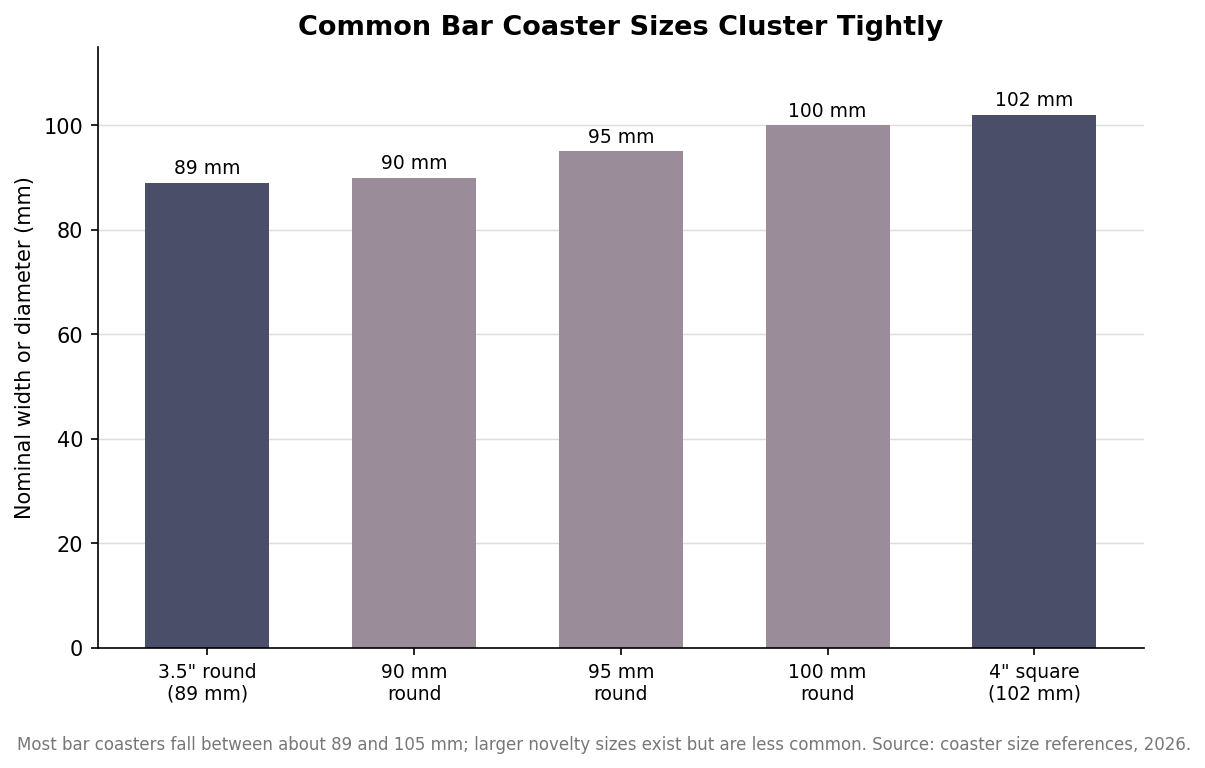
    Coaster sizes cluster more tightly than most people expect. In North America the everyday square coaster runs 4 inches on a side, about 102 millimeters, while classic beer coasters are often a slightly smaller 3.5 inches. Round coasters sold for bar use typically land between roughly 90 and 105 millimeters in diameter, with 90mm, 95mm, and 100mm being the workhorse options. A 3.5-inch round works out to about 89 millimeters, which is why so many quotes list similar-sounding numbers. Sizes larger than about 105 millimeters and specialty formats up to 6 inches exist, but they read as novelty and cost more per piece.

    Bar chart of common bar coaster nominal sizes in millimeters, ranging from a 3.5 inch round at 89 mm to a 4 inch square at 102 mm
    Common bar coaster sizes sit within a narrow 89 to 105 millimeter band.

    Match the size to the glassware, not just the logo. A 90 to 95 millimeter round comfortably catches the base and condensation of a standard pint or highball, while a 4-inch square gives a little more print area and a more contemporary look. If your venue serves wide-bottomed cocktail glasses or steins, size up to 100 millimeters or the 4-inch square so the rim never overhangs the mat. Shape is mostly an aesthetic call, though square coasters pack and stack more efficiently and give straight edges for a border, while rounds feel more traditional behind a bar.

    Reading thickness: points, millimeters, and feel

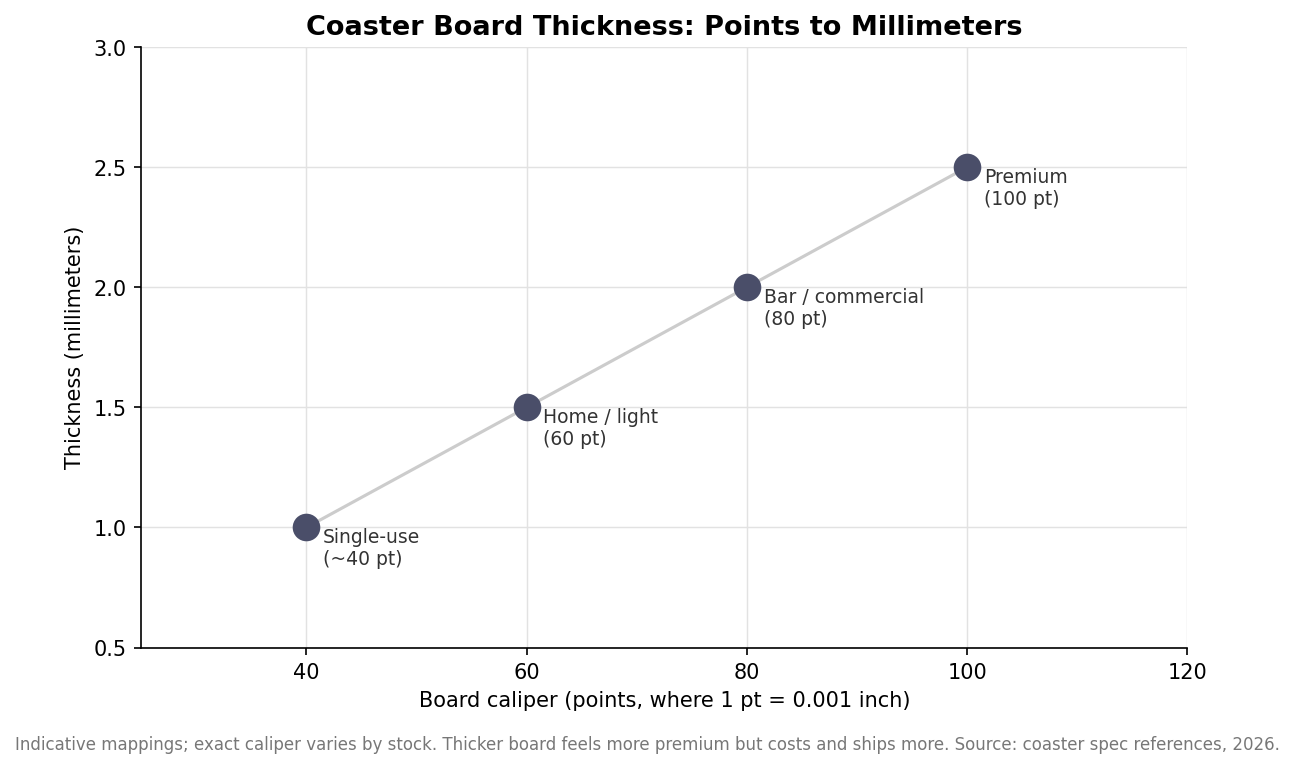
    Thickness is quoted two ways, and knowing both keeps you from over- or under-ordering. Printers often use points, where one point equals one thousandth of an inch, so a 40-point board is 0.040 inches, right around 1 millimeter. That lightweight stock suits single-use giveaway mats. A 60-point board, near 1.5 millimeters, is a sturdier everyday weight. Commercial bar and restaurant coasters commonly run about 80 points, close to 2 millimeters, thick enough to feel substantial and to soak up spills through a full shift. Premium and specialty boards climb to 100 points and beyond. The relationship is linear, so once you know that 80 points equals roughly 2 millimeters, you can translate any quote in your head.

    Scatter plot mapping coaster board thickness in points to millimeters, from 40 point single-use at 1 mm to 100 point premium at 2.5 mm
    Board thickness converts cleanly between points and millimeters; 80 point stock is a common bar-grade weight.

    Thicker is not automatically better. Heavier board feels more premium in the hand, resists curling, and lasts longer, but it also costs more per unit and adds shipping weight across a large order. For a promotional coaster that a customer takes home once, a lighter board is fine. For a coaster that lives on the bar and gets wet dozens of times a day, spend the extra for 80-point stock or heavier, because absorbency and rigidity are exactly what you are paying for.

    Set up artwork for a clean cut

    The single most common cause of a disappointing coaster is artwork that was not built for trimming. Printers cut through a stack of board, and the blade never lands in precisely the same spot on every piece, so your file needs to account for that tolerance in two directions. First, extend any background color or image past the finished edge to create bleed; a quarter inch of bleed beyond the cut line is a common requirement and keeps a stray white sliver from appearing if the cut drifts outward. Second, pull anything you cannot afford to lose, logos, text, and key graphics, inward from the edge into a safe area, typically about three sixteenths of an inch inside the cut line, so nothing important gets shaved off if the cut drifts inward.

    Build the file at print resolution in the right color space. Artwork should be 300 dpi or higher at the actual finished size, and it should be supplied in CMYK rather than RGB, because that is how the press mixes ink. A logo that looks crisp on screen at 72 dpi will print soft and pixelated, and bright RGB colors can shift noticeably when converted to CMYK, so it is worth confirming your key brand colors as CMYK or spot values before you approve anything. Vector files, such as an Illustrator EPS or a properly built PDF with outlined text, reproduce most reliably because they scale without losing sharpness.

    Stock, absorbency, and finish

    The board itself shapes how the print looks and how the coaster performs. Uncoated pulpboard is absorbent and matte, giving that traditional beer-mat feel and soaking up condensation, though colors read a touch softer as the ink sinks in. Coated or heavier coaster boards hold color more vividly and can take a smoother finish, at the cost of some absorbency. If your design is a full-bleed photograph or a rich solid color, a coated stock will make it pop; if the coaster’s main job is catching drips on a busy bar, absorbency should win. Ask to see the stock options, and if you can, request a physical sample so you can judge both the print and the way the board handles a splash of water.

    Quantities, proofs, and lead time

    Custom coasters are usually priced in tiers, so the per-piece cost drops sharply as quantity rises; ordering 5,000 rather than 1,000 often costs far less than five times as much. Decide your real quantity before requesting quotes so you are comparing the same volume across vendors. Always ask for a proof, ideally a printed one but at minimum a digital layout showing the cut line, bleed, and safe area, and check it against your file before you approve production. Confirm the lead time in writing too, since coaster runs commonly take one to three weeks depending on stock, finishing, and shipping, and event coasters in particular need a comfortable buffer. A short pre-order checklist keeps you honest: finished size and shape chosen, thickness specified in points or millimeters, artwork built at 300 dpi in CMYK with bleed and a safe area, stock selected, quantity locked, and a proof reviewed. Run through those six items and the coasters that arrive will match the ones you pictured.

  • The Back of the Coaster Is the Best Ad Space in the Bar

    Every venue is full of print nobody reads and one small piece of print everybody handles. Most brands leave half of it empty.

    Why people turn a coaster over

    Waiting for a round is dead time, and picking up the thing in front of you is a socially acceptable way to spend it. Turning it over is the obvious next move.

    No poster on the wall gets picked up. No table talker gets flipped. The coaster is unique in the room.

    Two faces, two completely different readers

    The front is seen across a table by somebody mid-conversation who is not looking at it. It has to work at a glance: bold, simple, one idea.

    The reverse is read from thirty centimetres by somebody with nothing else to do. It can carry sentences, a question, a code, a date, a story about the beer.

    What works on the back

    Offers and codes, obviously. But quiz questions travel furthest — they get read out loud, and a mat that gets read out loud has just advertised to the whole table. Serving notes stop your staff being asked the same question all night. Event dates go home in a pocket.

    Run several different backs across one print run; the setup is shared, so it costs very little and turns the mats into a set.

    The cost of leaving it blank

    Nothing is saved. The board is the same, the run is the same, the distribution is the same. A blank reverse is simply a placement you paid for and did not use.

    We print both faces as standard for exactly that reason.

  • Why Beer Mats Curl

    Every cupped, rocking, half-binned beer mat you have ever seen is the same piece of physics happening on a bar. It is worth two minutes.

    Absorption is one-sided

    A glass sits on the top face, condensation runs down onto the top face, and spills land on the top face. The underside spends the whole evening against a dry bar.

    Pulpboard fibres swell as they take up water. One side of the sheet gets longer; the other does not.

    A sheet that is longer on one side is a dish

    There is nowhere else for the extra length to go. The mat cups, lifting its edges, and now it sits on three points instead of its whole face.

    That is when it starts sliding under a glass, and that is when bar staff start throwing it away.

    What actually controls it

    Board choice first: how much fibre there is, how compressed it is, and how fast it takes water. Then grain direction, which decides which axis the sheet prefers to move on — run it right and the cupping is far less pronounced.

    Both are decisions somebody makes at the mill and at the press. Ours are written on the quote; most are not written anywhere.

    The ten-minute test

    Wet the top of a mat, set it down, and walk away. Come back in ten minutes and look at the corners.

    Flat means somebody specified the board. A shallow dish means you bought whatever was on the shelf, and it will be in a bin by ten o’clock.

  • The Complete Buyer’s Guide to Custom Bar Coasters

    Bar coasters get ordered by the ten thousand off a price per unit and judged by whoever sweeps up. These four checks close the gap.

    Ask for two board numbers, not one word

    Grammage is how much board there is by weight; caliper is how thick it is. A compressed board and a bulky one can weigh the same and behave completely differently under a wet glass.

    ‘Standard’ and ‘premium’ are price tiers. Numbers are a specification.

    Ask which way the grain runs

    A mat only gets wet on the top face, so it swells on one side and cups. Grain direction is most of what decides how far it goes.

    It is a free thing to get right and almost nobody is asked for it.

    Check the cut edge

    Run a fingernail round the rim. A clean, compressed edge means a sharp die on the right board. A furred, fibrous one means neither, and it will look worse by the second round.

    This is the cheapest quality signal in the whole product.

    Then use the back

    The reverse of a coaster is the best-read surface in a venue: close range, willing reader, time to spare. It is also usually blank.

    Design the two faces as two different jobs and one mat does the work of two placements.

    Finally, buy against a file

    Board, grain, inks, coatings and PMS held on record is the only thing that stops a caliper quietly thinning between pallets.

    The product is simple. Buying it well is a spec sheet, and now you have one.

  • Custom Bar Coaster Materials: Pulpboard vs. Coaster Board vs. Rubber

    Custom Bar Coaster Materials: Pulpboard vs. Coaster Board vs. Rubber

    Most bars order coasters twice: once because someone said they needed them, and once again three months later after the first batch turned to mush in the ice well. The difference between those two orders is almost always the stock — not the artwork, not the printer, and not the price.

    This guide walks through what actually separates coaster materials, where the price curve bends, and how to spec an order you won’t have to redo.

    The three materials that matter

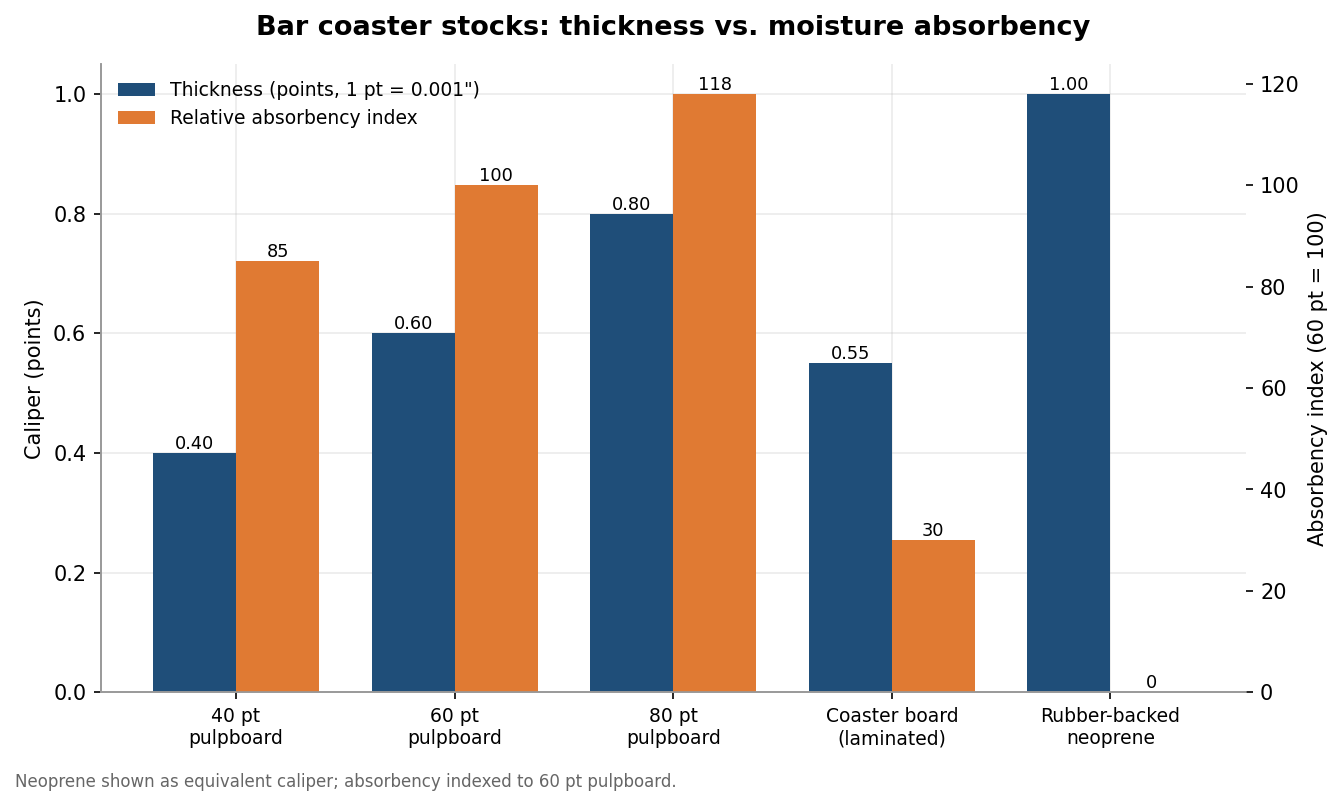
    Pulpboard is the classic bar coaster: absorbent, matte, slightly fuzzy at the edge, and printed on a single pass. It exists to soak up condensation, and it does that better than anything else at the price. It is also disposable by design — customers take them home, which is precisely the point if you’re using them as a marketing piece.

    Coaster board (sometimes sold as “laminated” or “photo finish” coaster stock) trades absorbency for a glossy, photographic surface. Colors are noticeably richer and the sheet resists staining, but a wet glass will bead on top of it rather than wick into it. It suits upscale cocktail programs and event work more than a high-volume tap room.

    Rubber-backed neoprene is a different product entirely. It’s washable, permanent, and grips the bar top, which makes it a service tool rather than a giveaway. Expect roughly five to ten times the unit cost of pulpboard, and expect it to stay behind the bar.

    Bar chart comparing thickness in points and relative absorbency for 40pt, 60pt and 80pt pulpboard, laminated coaster board, and rubber-backed neoprene coasters
    Thicker stock absorbs more, but laminated and rubber options trade absorbency for durability and finish.

    Thickness: what the “point” number actually buys you

    Coaster stock is measured in points, where one point equals one thousandth of an inch. The three common weights behave quite differently in service:

    40 pt is the light-duty option. It’s fine for a one-night event, a wedding, or a promotional mailer insert, and it’s the cheapest way to get your artwork into someone’s hand. Under a sweating pint glass for a full evening, it will curl.

    60 pt is the working standard, and it’s what most breweries and bars should default to. It holds its shape through a full glass, stacks cleanly in a caddy, and survives being carried home in a coat pocket — which is where a lot of your marketing value actually gets realized.

    80 pt is the premium weight. It feels substantially more expensive in the hand than the roughly 30% price premium it commands, which makes it a reasonable upgrade for a brand launch, a taproom opening, or anything you want guests to keep. It’s overkill for weekly service volume.

    Where the price actually breaks

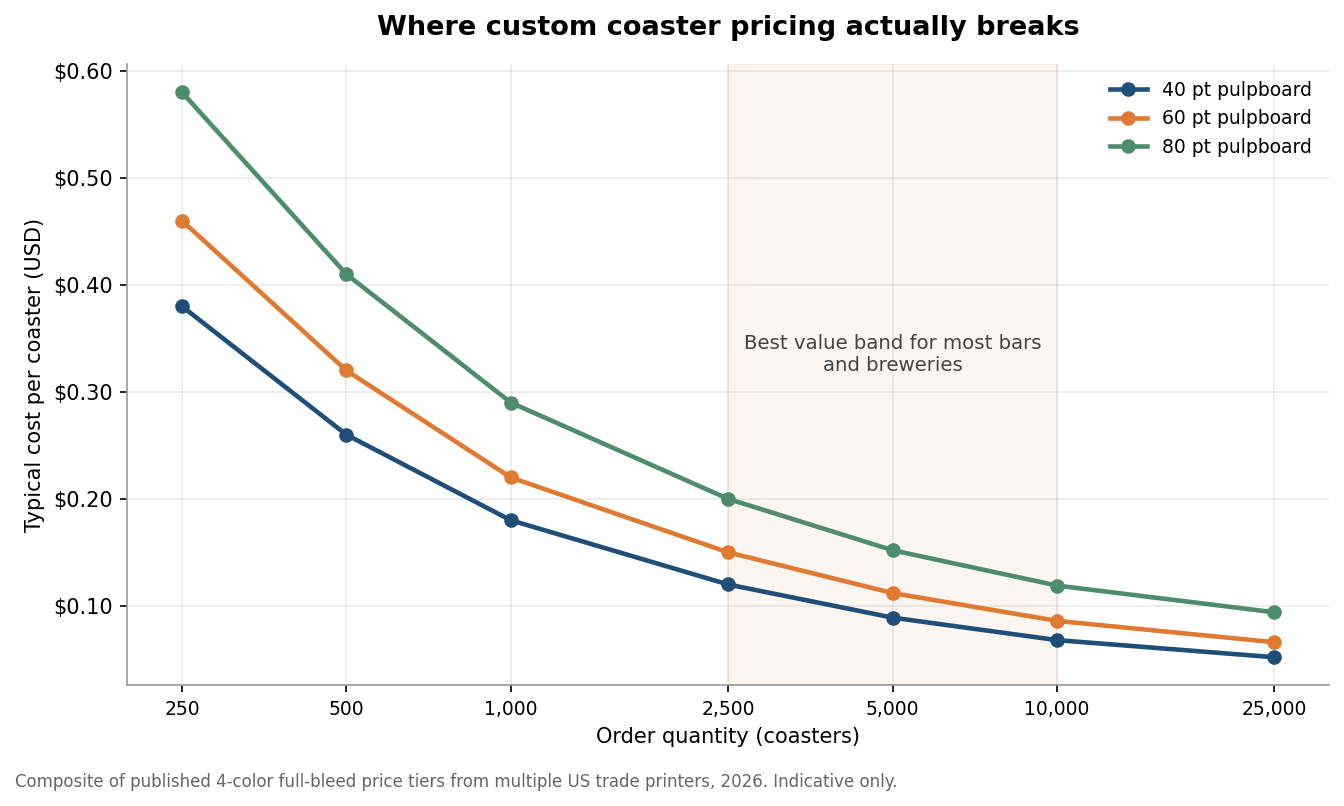
    Coaster pricing is dominated by setup, not material. Plates, dies, and press make-ready are fixed costs spread across the run, which means the per-unit number falls steeply through the first few thousand pieces and then flattens out.

    Line chart showing cost per custom coaster falling as order quantity rises from 250 to 25,000 across 40pt, 60pt and 80pt pulpboard
    Per-unit cost falls steeply to about 2,500 pieces, then flattens — the 2,500–10,000 band is where most venues get the best value.

    The practical consequence: ordering 1,000 coasters instead of 2,500 rarely saves you much money in absolute terms, because you’re paying nearly the same setup either way. If you go through coasters at any real rate, the 2,500 to 10,000 band is where the economics stop punishing you. Below 500, you’re mostly buying setup.

    One caveat worth pricing out before you commit: die-cut custom shapes add a one-time die charge, typically in the $75–$150 range. On a 500-piece order that’s a meaningful percentage. On a 5,000-piece order it disappears into the noise, and the die is usually kept on file for reorders.

    Specifying an order that comes back right

    A few details cause most of the reprints:

    Bleed and safety margin. Coasters are die-cut, and die-cutting drifts. Extend background art at least 0.125″ past the trim edge and keep logos and text at least 0.25″ inside it. A logo that sits tight to the edge in your artwork file will get clipped on some percentage of the run — that’s the process, not the printer.

    Ink coverage on pulpboard. Absorbent stock drinks ink, so colors dry back lighter and softer than they look on screen. Heavy solid coverage — a full-bleed black or a deep navy — will look chalky. If your brand depends on a precise color match, either move to coaster board or accept that the pulpboard version will read a shade or two lighter.

    One side or two. Two-sided printing typically adds 20–30% to the unit cost and is worth it more often than people expect: the back is where a QR code, an event hashtag, or a “we’re hiring” line goes, and a coaster spends half its life face-down.

    Lead time. Standard production runs 7–12 business days after proof approval, plus transit. Build in the proof cycle — it’s the step that slips, and it’s the step you don’t want to skip.

    A simple default

    If you don’t want to think about it: 60 pt pulpboard, 3.5″ round or 4″ square, full-color both sides, 2,500 pieces, with 0.125″ bleed. That covers ordinary service volume for most venues, lands in the flat part of the price curve, and produces a coaster sturdy enough that people take it home.

    Upgrade to 80 pt when the coaster is doing brand work rather than table work. Move to coaster board when the artwork is photographic. Buy neoprene only when you want the coaster to stay on the bar.

  • Hello world!

    Welcome to WordPress. This is your first post. Edit or delete it, then start writing!